
What Counts as Evidence in a Claim? 7 Ways to Evaluate It
What counts as evidence in a claim is one of the most misunderstood questions online. Screenshots spread fast. Viral clips spread faster. Actual evidence moves slower because it takes time to verify.
If a claim cannot be traced to a source, checked independently, and understood in context, it should not be treated as established evidence.
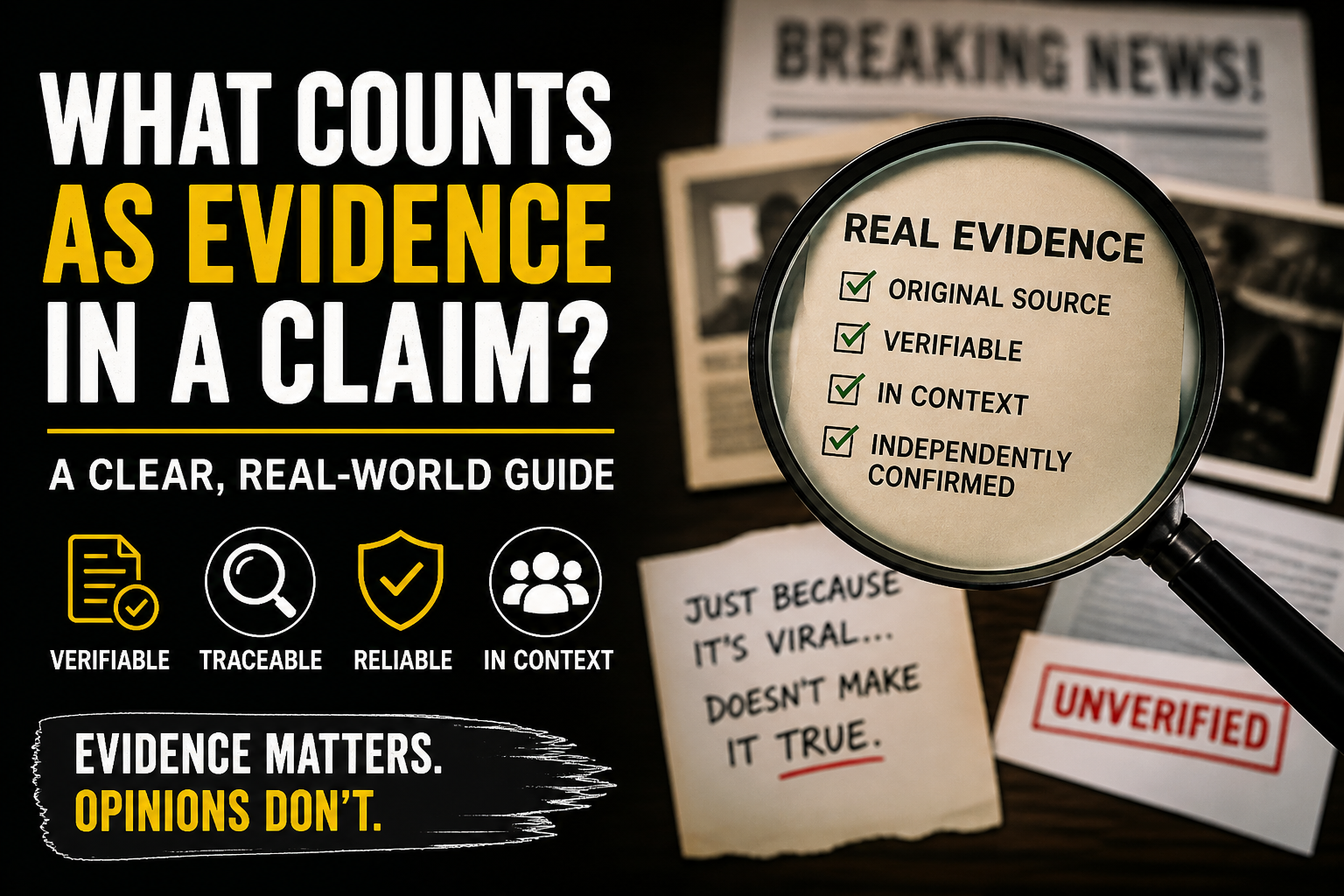
7 Proven Ways to Identify Real Evidence in a Claim
Instead of guessing, use a simple system. Real evidence follows patterns that can be checked. It does not depend on who shared it, how angry it made people, or how many times it appeared in your feed.
- Traceable: You can find the original source.
- Verifiable: Other people can confirm it.
- In context: It is not clipped, edited, or separated from important details.
- Primary: It comes from direct records, firsthand data, official documents, full transcripts, or original video.
- Consistent: It matches other credible sources.
- Complete: It shows the full picture, not only the part that helps one side.
- Transparent: The source is clearly identified.
Before trusting any claim, run it through the 20 Questions checklist. Weak claims usually fail fast.
What Does Not Count as Evidence?
Most misinformation does not look fake at first. It usually looks confident, emotional, and easy to repeat. That is why weak evidence spreads so quickly.
- Screenshots with no original source
- Short clips missing full context
- Quotes without links to the full statement
- Anonymous claims with no corroboration or accountable reporting
- Posts designed to trigger emotion instead of provide proof
- Stories that cannot be checked anywhere else
If it cannot be checked, treat it as unverified. That is where most bad information spreads.
Why Evidence Matters More Than Opinion
Opinion explains what someone believes. Evidence shows what can be proven.
A confident claim can still be wrong. A widely shared claim can still be false. A political claim can feel true because it matches what someone already believes. None of that makes it evidence.
The process outlined in How We Verify Evidence uses the same standard every time. What can actually be proven, not what sounds convincing.
How to Check Evidence Yourself
You do not need special access, expert training, or a newsroom badge. You need a repeatable process.
- Find the original source of the claim.
- Check whether the source is complete and in context.
- Look for independent confirmation.
- Compare the claim to official records or reliable reporting.
- Separate what happened from what someone thinks it means.
If you want to go deeper, use the Verify a Claim page to search for evidence tied to real claims.
Real Example: Weak Evidence vs Strong Evidence
Weak evidence: A viral post claims something happened but provides no source.
Stronger evidence: A report links to the original record, shows the full context, and can be confirmed by other reliable sources.
Strong evidence: The claim is backed by official records, full video or audio, public documents, direct data, and independent confirmation.
The difference is not popularity. The difference is verification.
Why This Matters Online
Bad claims spread because people react before they check. That is human. Many online platforms reward speed, emotion, and repetition through attention and engagement. Evidence requires the opposite. It requires slowing down long enough to ask where the claim came from and whether it can survive scrutiny.
That does not mean every claim is false. It means every serious claim deserves a serious check.
When people skip that step, rumors become talking points. Talking points become beliefs. Beliefs become political identity. Once a claim becomes part of political identity, corrections can become harder to accept.
What Counts as Evidence in a Claim? The Bottom Line
What counts as evidence in a claim is simple. It must be traceable, verifiable, reliable, and in context.
If a claim cannot meet those standards, it should not be treated as fact.
If someone believes their claim holds up, they can submit it to the 10K Truth Challenge. Prove it. Win. That is the standard.
FAQ: What Counts as Evidence in a Claim?
What counts as evidence in a claim?
Evidence in a claim is information that can be traced, checked, verified, and reviewed in context. Strong evidence usually comes from primary sources, official records, full documents, direct data, or credible reporting.
What does not count as strong evidence?
Screenshots with no source, cropped clips, uncorroborated anonymous claims, emotional reactions, and viral posts without documentation usually do not count as strong evidence.
Why does context matter when checking evidence?
Context matters because a real quote, image, video, or statistic can still mislead people if important surrounding information is removed.
How can I check evidence myself?
Start with the original source, review the full context, compare reliable sources, and ask whether the evidence actually supports the claim being made.
Related Evidence Matters Pages
Keywords for the Curious
what counts as evidence in a claim, real evidence examples, how to verify a claim, fact checking evidence, evidence vs opinion examples, primary source proof, misinformation verification
How we rate claims: See the Evidence Matters Verdict System