
About Evidence Matters
About Evidence Matters starts with one simple idea. Too many public claims get repeated, shared, and believed before anyone slows down to check whether the evidence actually holds up.
This site tracks public claims, links the strongest available record, and explains in plain English what the evidence supports, what it does not support, and what still is not known.
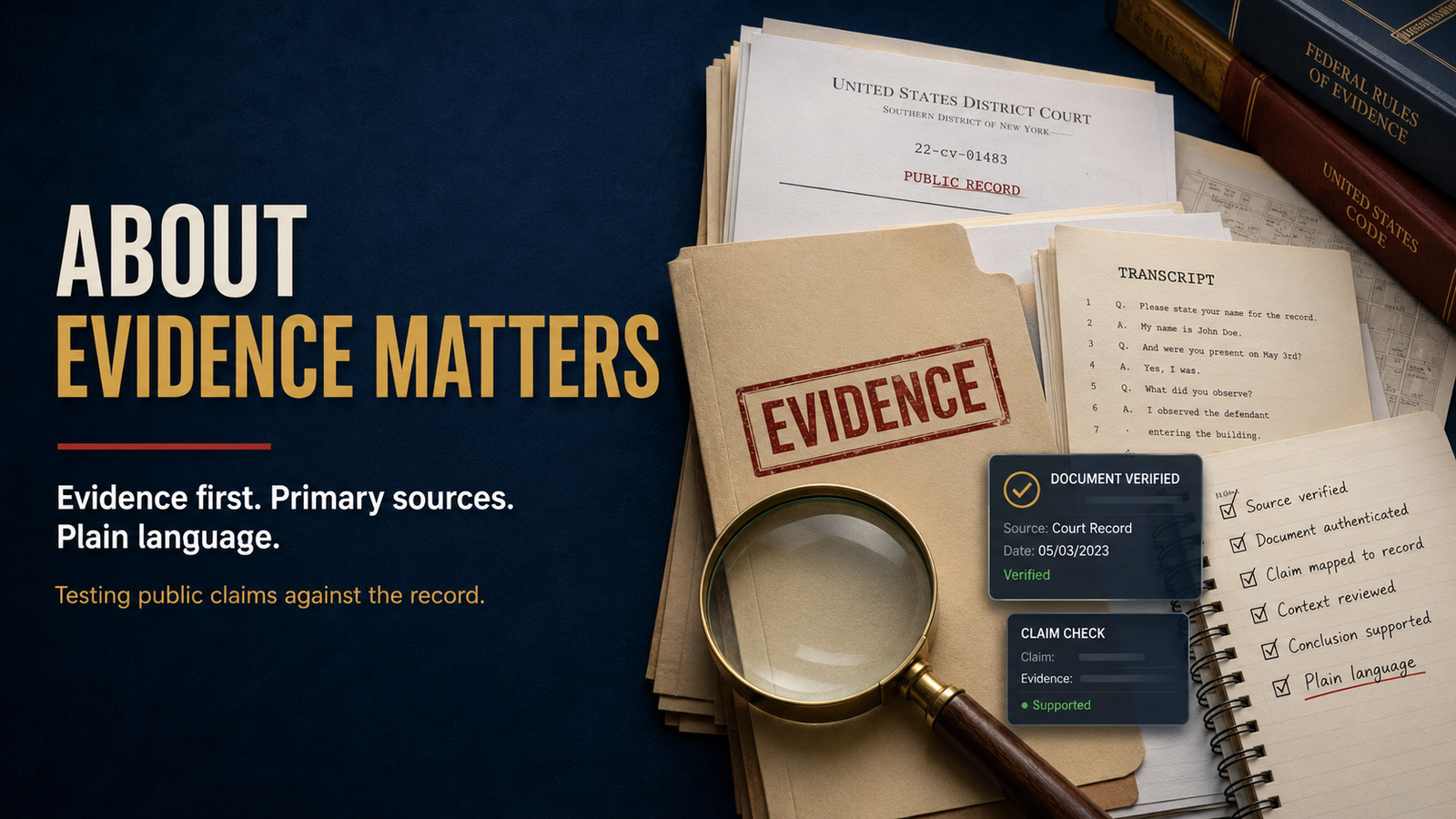
About Evidence Matters: What this site does
About Evidence Matters is really about one thing. Slowing down long enough to test public claims against evidence instead of repetition, identity, or partisan spin.
Evidence Matters is a public claim review and media literacy project. We look at political claims, viral rumors, conspiracy narratives, edited clips, screenshots, and other forms of public persuasion that spread faster than careful verification.
For each claim, we start with the strongest available record we can find. That usually means court filings, official documents, full transcripts, full video, public datasets, agency reports, legislative text, or other primary source material.
Then we explain what the evidence supports, what it does not support, and what remains uncertain. If sources conflict, we say that plainly instead of smoothing it over.
This approach lines up with widely used guidance on checking sources, context, and original records before accepting a claim as true. See Google’s guide to evaluating information and sources.
About Evidence Matters: Why this site exists
Because public life falls apart when repetition matters more than evidence.
A lot of people are drowning in clips, headlines, influencers, and partisan noise. The result is predictable. Weak claims get repeated until they feel true. Emotional stories outrun careful records. Loyalty starts replacing verification.
Evidence Matters was built to push back on that. Not by asking people to trust another loud voice, but by making it easier to slow down, check the claim, and look at the actual record.
The goal is simple. Fine. Now show the evidence.
How we approach a claim
A simple, repeatable method you can use here or on your own.
1. Be specific
Strip the claim down to one clear sentence with a real actor, date, place, and action. If the claim stays vague, it stays slippery.
2. Start with the record
Prefer documents over commentary. Prefer full clips over edited snippets. Prefer original sources over people talking about the source.
3. Show the work
Link the source, explain the reasoning, and make it easy for other people to check the same trail themselves.
FABLE quick check
When you need a fast filter, use FABLE. It is not a substitute for full research. It is a way to slow down and stop weak claims from getting a free pass.
The FABLE framework is used here as a practical tool for evaluating claims and information sources. Similar evaluation models are used across media literacy and fact-checking work.
This is only the quick check. For the full review process, read How we verify.
For verdict labels and how conclusions are assigned, see the Evidence Matters Verdict System.
- Focus. What exactly is being claimed.
- Authority. Who is saying it and why trust them.
- Bias. What do they gain if you believe it.
- Logic. Does it still make sense when you slow down.
- Evidence. Where are the documents, data, or full clip.
About Evidence Matters: How to use this site
If you are new here, these are the best places to start.
Read an audit
Start with a breakdown that compares a public claim to the strongest available evidence and explains the gap between the story and the record.
Use the checklist
Even a short check can stop bad information from spreading. Use the checklist before you share a clip, image, or viral claim.
Send for review
If a claim is spreading fast, send it in. Links are best. Screenshots help, but a direct source is better.
What makes this different
The point is not to win a tribal argument. The point is to see what survives scrutiny.
Evidence over slogans
A slogan can spread in seconds. A real record takes longer. This site is built for the slower part.
We are more interested in what can be checked than in what sounds good on a post, clip, or rant.
Clarity over spin
A claim can be popular and still fail. A claim can be emotionally satisfying and still be weak. This site tries to separate heat from evidence.
When something is uncertain, it should be called uncertain. When something falls apart, it should be called weak.
The 10K Truth Challenge
The jackpot does not have to be life changing. It only has to be excuse killing.
Why $10,000 is enough
Some people ask whether $10,000 is enough money for someone to come forward with evidence that the 2020 election was stolen.
That question misses the point.
If someone truly has evidence that a presidential election was stolen, they should not need a jackpot to reveal it. They should reveal it because it would be one of the most important discoveries in American political history.
The money is not here to buy the truth. The money is here to remove the excuse.
At $100, someone could say it is not worth their time. At $1,000, that excuse gets weaker. At $10,000, it becomes very hard to believe that nobody in America would claim the reward if real evidence existed.
If the evidence is real, someone should be able to claim the money.
If nobody can claim the money, then the missing claimant becomes part of the story.
The challenge is simple:
Show the evidence, claim the money.
If nobody can show the evidence, stop pretending it exists.
Put it to the test
If you think you have proof for a major public claim, do not just post it and hope people clap. Bring it to the 10K Truth Challenge.
If the evidence holds up, it should survive scrutiny.
Sources for the curious: court records, official agency sites, legislative text, inspector general reports, public datasets, full interviews, full transcripts, and Google’s guidance on evaluating information and sources.