
7 Reasons “Sanctuary Cities Protect Criminals” Is a Misleading Claim
Sanctuary cities protect criminals is the political slogan. The reality is more specific, more legal, and a lot less useful for fear based politics.
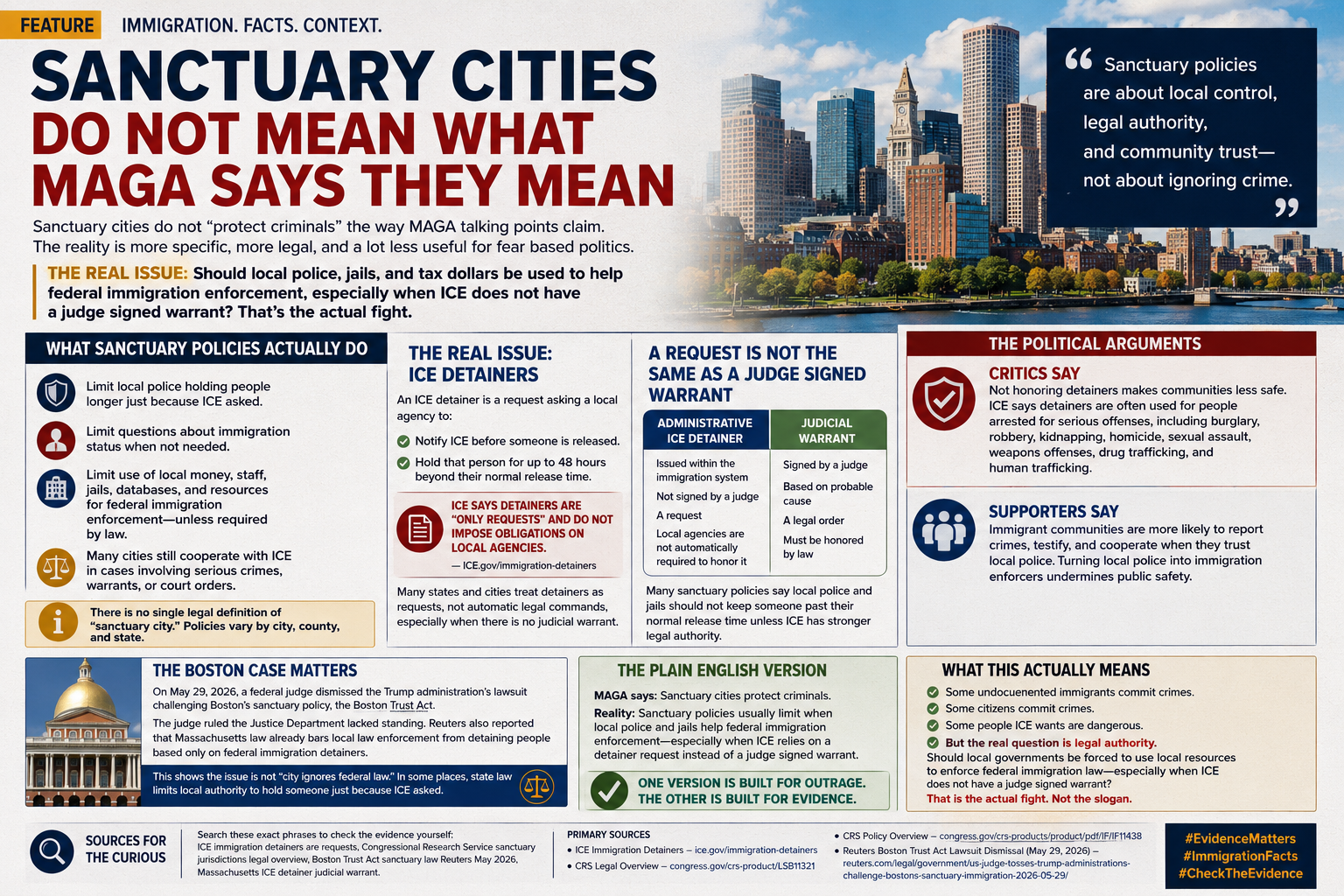
The claim that sanctuary cities protect criminals works because it sounds simple. But simple is not the same thing as true. The real issue is whether local police, local jails, local tax dollars, and local databases should be used to help federal immigration enforcement, especially when ICE does not have a judge signed warrant.
Why “Sanctuary Cities Protect Criminals” Needs Evidence
The phrase sanctuary cities protect criminals gets repeated because it is emotionally powerful. But emotional power is not evidence.
When people say sanctuary cities protect criminals, they usually skip the legal details that matter most. They skip ICE detainers. They skip judge signed warrants. They skip the difference between local criminal law and federal civil immigration enforcement.
That is why the claim needs to be checked carefully. Sanctuary cities protect criminals is a broad accusation, and broad accusations should be supported by specific evidence.
“Sanctuary Cities Protect Criminals” Is the Slogan
The phrase sanctuary cities protect criminals is designed to do one thing.
It is designed to make people stop thinking.
The problem with the phrase sanctuary cities protect criminals is that it turns a legal process question into a fear based accusation.
It takes a complicated legal issue and turns it into a cartoon. In that cartoon, local leaders see dangerous criminals and say, “Come on in. We will protect you.”
That is not how sanctuary policies usually work.
Most sanctuary policies do not say local police must ignore murder, robbery, assault, theft, domestic violence, or other crimes. Local police still arrest people. Prosecutors still bring charges. Courts still handle criminal cases. Jails still hold people when local law allows it.
The actual dispute is what happens after the local criminal process says a person should be released, and ICE asks the local jail to hold that person longer for federal immigration enforcement.
The Real Issue Is ICE Detainers
A major part of this fight centers on ICE detainers.
ICE describes an immigration detainer as a request asking a local, state, or federal law enforcement agency to notify ICE before someone is released and to hold that person for up to 48 hours beyond the time they would normally be released.
That last part matters.
If a local case is finished, charges are dropped, bond is posted, a sentence is complete, or a court orders release, ICE may still ask the jail to keep the person longer. Some sanctuary policies say local officials should not do that based only on an ICE administrative request.
That is why sanctuary cities protect criminals is not a complete explanation. The real question is whether a local jail should keep holding someone after local law says that person should be released.
That is not the same as saying crime does not matter.
It is saying custody has rules.
A Request Is Not the Same as a Judge Signed Warrant
This is the part the slogan usually hides.
An ICE detainer is not the same thing as a judge signed criminal warrant. ICE itself says detainers are requests. That means local agencies are not automatically required to honor them in every case.
Many sanctuary policies are built around that distinction. They say local police should not keep someone in jail past their normal release time unless ICE has stronger legal authority, such as a judicial warrant or another clear legal requirement.
If ICE has stronger legal authority, the situation changes. But when ICE is relying only on a detainer request, the claim sanctuary cities protect criminals leaves out the entire warrant issue.
That is why the phrase “protecting criminals” is misleading. The argument is not really about whether dangerous people should face consequences. The argument is about who has the legal authority to keep someone locked up, and under what process.
Undocumented Does Not Automatically Mean Criminal
This is another place where political language muddies the water.
Being undocumented is generally a civil immigration issue. That does not mean immigration law is fake. It does not mean federal law does not matter. It means immigration enforcement is usually handled through a different legal system than local criminal prosecution.
MAGA rhetoric often collapses everything into one word: criminal.
That lets them treat a person accused of a violent crime, a person with an old immigration violation, a person who overstayed a visa, and a person who has not been convicted of anything as if they are all the same.
They are not all the same.
That distinction matters because our legal system is supposed to care about process, evidence, charges, warrants, convictions, and authority. You know, all those boring little things that keep a country from becoming a revenge machine with paperwork.
Critics Do Have One Real Argument
To be fair, critics of sanctuary policies do have one serious argument.
ICE argues that when local jails do not honor detainers, federal officers may have to arrest people out in the community instead of taking custody of them from a jail. ICE says that can be more dangerous for officers, the public, and the person being arrested.
That concern should not be dismissed out of hand.
There are cases where ICE wants people who have been accused or convicted of serious crimes. There are cases where federal immigration enforcement and public safety overlap. Pretending otherwise is not honest.
But that still does not prove the slogan.
It proves there is a real policy tradeoff. It does not prove sanctuary cities protect criminals.
Sanctuary Supporters Also Have a Real Argument
Supporters of sanctuary policies argue that local police need trust from immigrant communities.
If victims, witnesses, parents, workers, and neighbors believe every contact with local government could turn into an immigration case, some people stop calling police. They stop reporting crimes. They stop cooperating as witnesses. They avoid public services. They disappear from normal civic life.
That can make communities less safe, not more safe.
The sanctuary argument is not “ignore crime.”
The sanctuary argument is, “Do not turn local policing into immigration enforcement, because then people stop trusting local police.”
The Boston Case Shows Why This Matters
In May 2026, a federal judge dismissed the Trump administration’s lawsuit challenging Boston’s sanctuary policy, known as the Boston Trust Act.
The administration argued that Boston’s policy obstructed federal immigration enforcement. Reuters also reported that Massachusetts law already bars local law enforcement from detaining people based only on federal immigration detainers.
That is a big deal.
It shows this debate is not as simple as “city ignores federal law.” In some places, local officials are saying they do not have legal authority under state law to hold someone just because ICE asked.
That is not lawlessness. That is a legal boundary.
The Plain English Version
Here is the clean version.
MAGA says sanctuary cities protect criminals.
The more accurate statement is this:
Sanctuary policies usually limit when local police and local jails help federal immigration enforcement, especially when ICE is relying on a detainer request instead of a judge signed warrant.
That is a very different claim.
One version is built for outrage.
The other version is built for evidence.
A Better Analogy
Imagine local police arrest someone for a local offense.
The case moves through the local system. Maybe the person posts bond. Maybe the charge is dropped. Maybe the sentence is complete. Maybe the court says the person should be released.
Then another agency says, “Hold that person longer for us.”
A sanctuary policy may answer, “Not unless you bring the proper legal authority.”
That is not the same as saying the original offense does not matter.
It is saying local jail custody is not supposed to run on shortcuts.
What This Actually Means
Some undocumented immigrants commit crimes. Some citizens commit crimes. Some people ICE wants are dangerous. That is true.
But the phrase sanctuary cities protect criminals is still misleading because it skips the real legal question.
The real question is this:
Should local governments be forced to use local police, local jails, local money, and local databases to help enforce federal immigration law, even when ICE does not have a judge signed warrant?
That is the actual fight.
Not the slogan.
Not the fear campaign.
Not the cartoon version where every undocumented person is treated like a violent criminal.
The evidence points to a more specific issue: local cooperation, federal immigration enforcement, detainer requests, warrants, and legal authority.
So when someone says sanctuary cities protect criminals, the right response is simple: show the evidence, show the warrant, and show the law being violated.
That is why the distinction matters.
How we rate claims: See the Evidence Matters Verdict System