
No Proof, No Power: 7 Evidence Standards for Political Leaders
No proof, no power means political leaders must prove the claim behind a demand before the public gives them more authority, more control, or fewer limits.
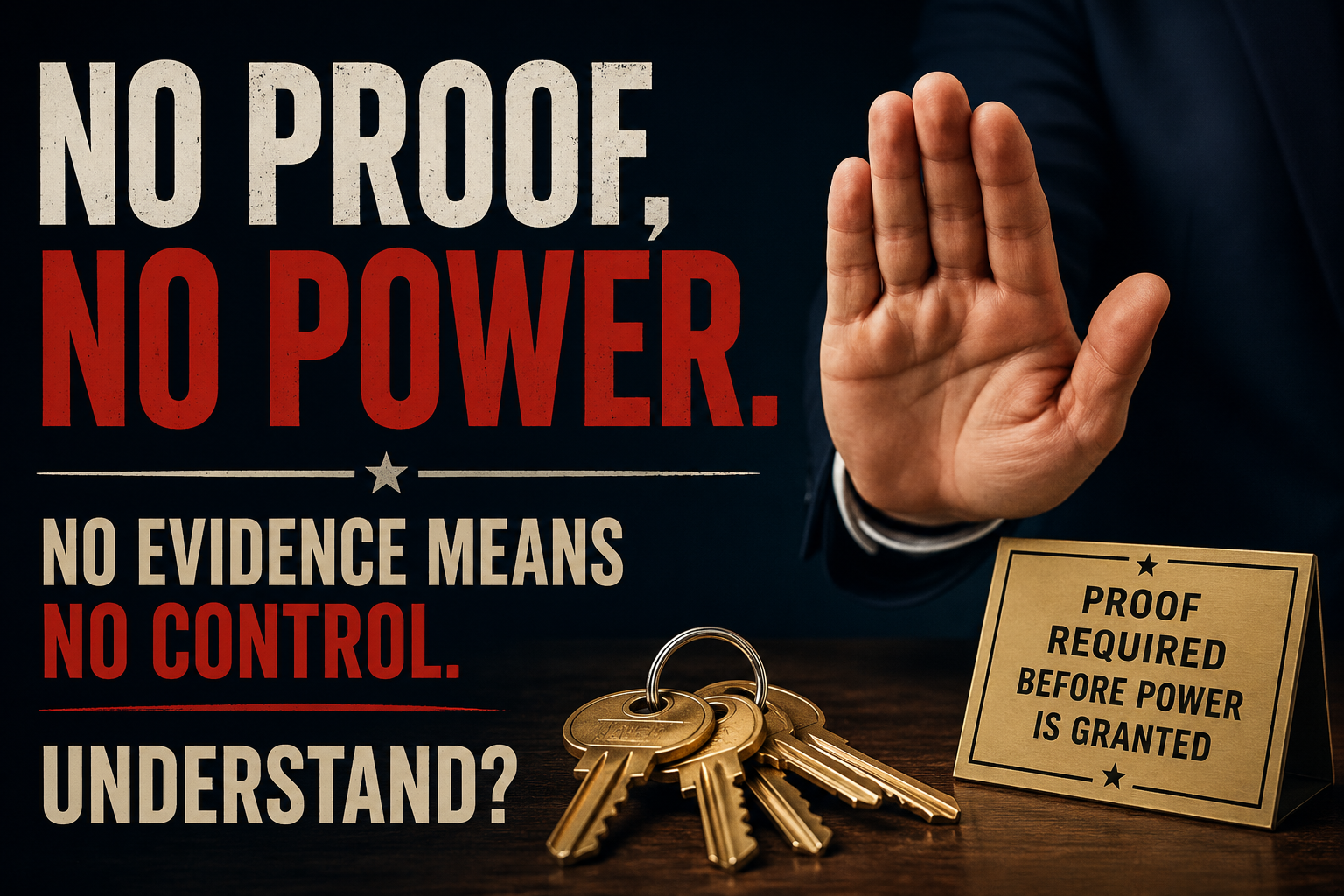
No proof, no power is a simple standard that should apply to every president, governor, mayor, candidate, political party, and public movement.
Before a leader receives more authority, more control, or more power over other people, the claim being used to justify that demand should be proven.
If a leader claims there is a crisis, show the evidence.
If a leader claims people are cheating, show the evidence.
If a leader claims an election was stolen, show the evidence.
If a leader claims constitutional rights must be restricted, show the evidence that justifies that restriction.
If a leader claims they need more power to save the country, the public should know exactly what problem exists, how large it is, what caused it, and why the proposed authority is necessary.
Evidence comes first. Power comes second.
What Does No Proof, No Power Mean?
No proof, no power means a political leader should not receive new authority based only on an accusation, slogan, prediction, rumor, or unsupported emergency claim.
Power should be tied to evidence.
The larger the demand, the stronger the evidence should be.
A routine administrative change may require a modest factual showing. A demand to overturn an election, suspend rights, punish a group, search homes, seize property, deploy force, or bypass ordinary constitutional limits requires far more.
The basic idea is similar to the legal concept known as the burden of proof. The person making a serious claim carries the responsibility to support it. The Cornell Legal Information Institute explains the burden of proof as the obligation to establish a disputed assertion.
The basic test: What claim is being made, what evidence proves it, and how does the proposed power solve the proven problem?
1. Define the Exact Claim
Before the public debates a solution, the leader asking for power should state the factual claim clearly.
Vague warnings such as “the system is broken,” “they are cheating,” or “the country is under attack” are not specific enough.
Citizens should ask:
- What exactly happened?
- Who was involved?
- Where did it happen?
- When did it happen?
- How many people, votes, dollars, or records were affected?
A leader should not receive broad authority to solve a problem that has never been clearly defined.
2. Show Verifiable Evidence
A claim is not evidence.
A rumor is not evidence.
A campaign slogan is not evidence.
A crowd chanting an accusation is not evidence.
A politician repeating the same story during every interview does not transform it into proof.
Evidence is the material used to determine whether the claim is accurate. It should be available for review, testing, comparison, challenge, and verification.
Depending on the claim, useful evidence may include:
- Public records
- Court documents
- Official data
- Complete transcripts
- Direct video or audio
- Financial records
- Audit findings
- Documented witness testimony
- Peer reviewed research
Read What Counts as Evidence in a Claim? for a deeper explanation of verifiable political evidence.
First prove that the problem is real. Then debate the solution.
3. Prove the Size of the Problem
Evidence that a problem occurred once does not prove that it is widespread.
One illegal vote does not prove an election was stolen. One dishonest employee does not prove an entire agency is corrupt. One mistake does not prove a coordinated conspiracy.
The evidence must support the size of the conclusion.
A leader asking for nationwide power should provide evidence of a nationwide problem. A leader asking to overturn an election should provide evidence showing enough affected votes to change the result.
Scale matters because small problems can be used to justify responses that are far larger than the evidence warrants.
4. Connect the Proposed Solution to the Evidence
Even when a real problem exists, the proposed solution must match it.
Government should not use a narrow problem as an excuse for unrelated authority.
Honest government should work in this order:
- State the exact claim.
- Show the supporting evidence.
- Prove the seriousness of the problem.
- Explain the proposed solution.
- Show how the solution addresses the proven facts.
- Disclose the likely costs and risks.
The dangerous version works backward:
- Create fear.
- Identify an enemy or scapegoat.
- Repeat an accusation.
- Demand immediate authority.
- Attack anyone who asks for evidence.
That is not evidence based leadership. It is manipulation.
5. Respect Rights and Legal Limits
Democracy depends on limits.
Leaders do not receive unlimited authority because they use frightening language. They do not get to punish people because they are angry. They do not get to overturn elections because they lost.
The United States Constitution divides and limits government power. The Constitution Annotated from Congress provides an official explanation of constitutional provisions and their legal interpretation.
The National Archives also provides the full United States Constitution and historical information about the document.
When evidence supports government action, citizens can still debate whether the response is constitutional, necessary, affordable, effective, and proportionate.
No evidence means no authority. No proof means no power.
6. Apply the Same Standard to Every Political Party
No proof, no power cannot be a partisan slogan.
It must apply to Republicans.
It must apply to Democrats.
It must apply to independents.
It must apply to presidents, governors, judges, prosecutors, legislators, police officials, activists, media figures, candidates, and political organizations.
When a Democrat makes a serious factual claim, ask for evidence.
When a Republican makes a serious factual claim, ask for evidence.
When your favorite politician makes a serious claim, ask for evidence.
When your least favorite politician makes a serious claim, ask for evidence.
The standard only matters when people use it even when the result is politically inconvenient.
7. Limit and Review Government Power
Genuine emergencies may require fast decisions. They do not make evidence irrelevant.
Leaders should still explain what happened, what information they are relying on, why immediate action is needed, and how the response is limited.
Citizens should also know:
- Who oversees the new authority
- How misuse will be detected
- What rights may be affected
- When the authority expires
- What evidence will be used to judge success
Temporary power should remain temporary.
Emergency claims should receive independent review.
Leaders should not be allowed to create a permanent atmosphere of crisis to escape accountability.
Everyday Examples Make the Rule Obvious
Most people already understand no proof, no power in ordinary life.
No proof, no keys
A stranger does not receive the keys to your building simply because he says there is a problem inside.
No proof, no search
Police do not generally receive unlimited permission to search a home because someone heard a rumor.
No proof, no insurance payment
An insurance company does not pay a major claim without documentation showing that the covered loss occurred.
No proof, no court victory
Filing a lawsuit does not prove the allegations in the lawsuit. Evidence must still satisfy legal scrutiny.
No proof, no election overturn
A losing candidate does not receive the office merely because they insist the certified result was unfair.
Overturning an election would require reliable evidence establishing what happened, how many votes were affected, and whether the verified total changed the outcome.
Read Election Fraud Evidence: Why an Investigation Is Not Proof for a detailed example.
Seven Questions to Ask Before Granting More Power
The No Proof, No Power Checklist
- What is the exact factual claim?
- What primary evidence supports it?
- Has the evidence been independently verified?
- How large is the proven problem?
- Does the proposed authority directly address it?
- What rights, costs, and risks are involved?
- What oversight and expiration limits prevent abuse?
These questions do not prevent government from solving real problems.
They make it harder for leaders to use imaginary, exaggerated, or unsupported problems to obtain real power.
The No Proof, No Power Series
This page is the starting point for a larger Evidence Matters series built around one basic democratic rule:
Before leaders receive power, they must prove the claim being used to justify it.
Planned articles include:
- No Proof, No Keys
- No Proof, No Search Warrant
- No Proof, No Insurance Payout
- No Proof, No Court Win
- No Proof, No Election Overturn
Same standard. Different examples. One rule.
The Bottom Line
The issue is not whether a policy sounds tough.
The issue is whether the evidence proves the need for that policy.
A serious country does not hand leaders more power because they created fear.
A serious country does not let politicians turn accusations into authority.
A serious country does not allow leaders to attack elections, rights, courts, agencies, cities, schools, immigrants, voters, or political opponents without evidence.
Evidence comes first.
Power comes second.
When the evidence is real, show it.
When the evidence does not support the claim, the claim should not receive government power.
No proof means no power. No evidence means no control.
Frequently Asked Questions About No Proof, No Power
What does no proof, no power mean?
No proof, no power means leaders should not receive additional authority based on an unsupported claim. They should first provide reliable evidence showing that the problem exists and that the proposed authority is necessary.
Does the standard apply to both political parties?
Yes. It should apply equally to Republicans, Democrats, independents, public officials, activists, candidates, and political organizations.
Does government need absolute proof before acting?
Not every government decision requires absolute certainty. Officials should still provide evidence strong enough to justify the seriousness, cost, scope, and legal consequences of the proposed action.
Why is a political claim not evidence?
A claim is the statement being evaluated. Evidence is the verifiable information used to determine whether that statement is accurate.
How does no proof, no power protect democracy?
It prevents leaders from using fear, rumors, false accusations, or exaggerated emergencies to obtain authority that the facts do not justify.
Sources for the Curious
This article is provided for civic education and media literacy. It is not legal advice. The Evidence Matters evaluates public claims by identifying the exact allegation, examining reliable sources, reviewing relevant evidence, restoring context, and limiting conclusions to what the record supports.
How we rate claims: See the Evidence Matters Verdict System