Verify Before You Share: 7 Simple Fact Checking Steps
Verify before you share political stories, viral videos, screenshots, and breaking claims. A few minutes of checking can stop misinformation before it spreads.
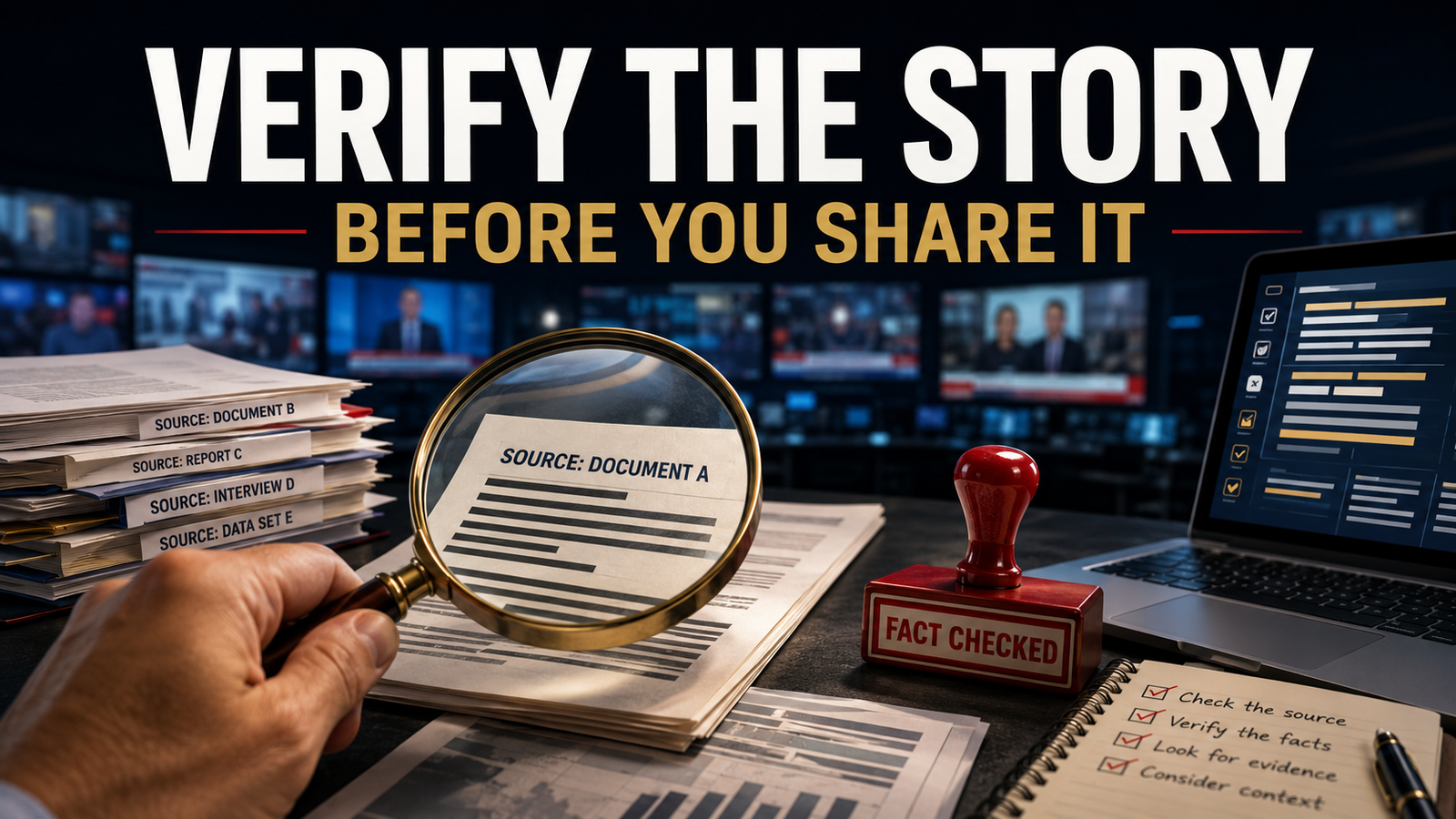
Verify before you share. That simple habit can prevent a misleading headline, edited video, fake screenshot, or unsupported political claim from reaching hundreds of other people.
There was a time when many Americans believed they could turn on the evening news and receive a basic shared version of reality.
That system was never perfect.
Journalists made mistakes. News organizations had biases. Important stories were missed or mishandled.
There was still a sense that serious professionals were expected to check facts, review evidence, and correct errors.
Today, news and political information come from television, websites, podcasts, social media, text messages, influencers, politicians, friends, family members, and algorithms.
Information travels faster than verification.
That means every person who shares a claim now has a small part in the verification process.
The old model was: “A trusted journalist told me what happened.” The new model must be: “Show me the original source.”
Verify Before You Share the Story
Do not share a political claim because it confirms what you already believe. Share it only after you have checked where it came from, what the original evidence shows, and whether important context is missing.
Why Media Trust Is No Longer Enough
Walter Cronkite became a symbol of trusted journalism because millions of Americans believed he was trying to report what happened rather than deliver a political performance.
Today, no single journalist or news organization has that level of national trust.
Media is fragmented, competitive, corporate, political, and driven by attention.
Algorithms reward content that produces anger, fear, shock, and immediate engagement.
That does not mean every journalist is dishonest.
It does not mean every news organization is fake.
It means blind trust is no longer a safe information strategy.
The answer is not to trust nothing. The answer is to stop trusting blindly.
Find the Original Source
A social media post is rarely the original source.
A meme is not a source.
A screenshot of a headline is not a source.
A television personality describing a report is not the report itself.
Follow links until you reach the document, video, transcript, court filing, audit, study, official statement, or public record behind the claim.
Ask whether the original source actually says what the post claims it says.
Read Past the Headline
Headlines are designed to attract attention.
They often remove qualifications, uncertainty, limitations, and context.
A headline may say a study proved something when the study only found a possible association.
A headline may say a court rejected evidence when the actual decision involved procedure, jurisdiction, standing, or an unsupported legal claim.
Read enough of the article to identify what happened, who made the claim, and what evidence supports it.
Check the Date and Location
Old stories are frequently reposted as though they happened today.
Videos from one country are sometimes mislabeled as events in another.
A photograph from one protest may be reused to describe an unrelated protest years later.
Before sharing, identify:
- When the event happened
- Where it happened
- Who recorded or published it
- Whether the description matches the original event
Correct footage can still be used to create a false story when the date or location is changed.
Look for Missing Context
Short clips can remove what happened before or after the selected moment.
A sentence can be technically accurate while creating a false overall impression.
Statistics can be misleading when they omit the time period, sample size, comparison group, or measurement method.
Look for the full video, complete transcript, complete data table, or entire court decision.
Ask what information would change how a reasonable person understands the claim.
A real quote, image, or statistic can still be used to create a false story when important context is removed.
Find Independent Confirmation
One source may make a mistake.
One political campaign may leave out facts that damage its argument.
One viral account may simply copy another viral account.
Look for confirmation from sources that did not all receive their information from the same post.
Strong confirmation may include an official record, local reporting, direct video, court documents, public data, and reporting from organizations with different political audiences.
Several websites repeating the same unsupported claim do not create independent evidence.
Separate Evidence From Interpretation
A document may establish that an event occurred.
It may not establish why it happened or what it means.
A court filing shows what one side alleges.
It does not automatically prove the allegation.
A witness statement shows what the witness claims to remember.
It still needs to be compared with records, other testimony, timing, and possible contradictions.
| Item | What It Can Establish | What It Does Not Automatically Prove |
|---|---|---|
| Viral video | Something visible happened during the recorded segment. | The full context, motive, frequency, or condition of an entire city. |
| Court filing | A party formally made specific allegations. | That the allegations are true or supported by sufficient evidence. |
| Affidavit | A person made a statement under specified conditions. | That every statement is accurate, complete, or independently verified. |
| Statistic | A measured result under a particular method and time period. | The cause, broader meaning, or result for every population. |
| Screenshot | Someone created or captured an image. | That the text is authentic, current, complete, or connected to the claimed source. |
Pause When a Story Triggers Strong Emotion
Anger makes people share quickly.
Fear makes people overlook missing information.
Political loyalty makes people apply different standards to claims that help their side.
A story that perfectly confirms everything you already believe deserves more scrutiny, not less.
Pause before sharing when a claim makes you immediately angry, frightened, triumphant, or eager to embarrass another group.
That emotional response may be exactly what the content was designed to produce.
Verify Before You Share Political Claims
Political misinformation works because people often check whether a claim supports their side before checking whether it is true.
A damaging story about the opposing party may be shared instantly.
A damaging story about the preferred party may be dismissed as fake news before the evidence is examined.
That is not media literacy.
It is political loyalty wearing a fact checker costume.
The standard should be the same no matter which party, candidate, or movement benefits.
Do not ask whether a story helps your side. Ask whether the story can be verified.
Cynicism Is Not Media Literacy
Some people respond to misinformation by saying nobody can be trusted.
That may sound independent or intelligent.
It can make people easier to manipulate.
If every source is dismissed, then nothing can be established.
If nothing can be established, the loudest person can invent reality.
Truth still exists.
Documents still exist.
Full videos, transcripts, court records, audits, public data, and original statements still exist.
The challenge is finding and evaluating them.
The Public Has a Verification Job
Every citizen now needs stronger evidence habits.
That does not mean everyone must become a journalist, lawyer, researcher, or historian.
It means ordinary people should stop spreading claims they have not checked.
- Do not confuse confidence with proof.
- Do not confuse repetition with evidence.
- Do not confuse a short clip with the complete event.
- Do not confuse an accusation with a verified finding.
- Do not let an algorithm decide what you believe.
Verify before you share because every repost helps determine which claims become part of public conversation.
Verify Before You Share: The Bottom Line
There may be no single Walter Cronkite trusted by the entire country.
That does not mean Americans should give up on truth.
It means people must stop outsourcing truth completely.
Before believing a story, verify the story.
Before repeating a claim, check the claim.
Before spreading outrage, look for the evidence.
Show me the source. Show me the document. Show me the full quote. Show me the evidence.
Verify Before You Share: Frequently Asked Questions
What should I check before sharing a political story?
Check the original source, publication date, location, complete context, supporting evidence, and independent confirmation.
Is a screenshot reliable evidence?
Not by itself. Screenshots can be altered, cropped, outdated, or disconnected from the account or webpage they supposedly represent.
Does a court filing prove an allegation?
No. A court filing documents what a party alleges. The evidence and legal arguments still need to be evaluated.
Can a real video create a false impression?
Yes. A real recording can be mislabeled, edited, taken out of context, or presented as representative of a much larger population.
Should I distrust every media organization?
No. The better approach is to evaluate each claim, identify its sources, compare coverage, and look for corrections and transparent evidence.
Why is emotional content more likely to spread?
Content that produces anger, fear, or triumph encourages immediate engagement before people slow down to verify it.
Helpful Verification Resources
This article provides general media literacy guidance. No checklist can guarantee that every claim will be evaluated correctly. Reliable verification often requires reviewing complete records, comparing independent sources, understanding relevant limitations, and correcting conclusions when better evidence becomes available. Updated August 5, 2026.
How we rate claims: See the Evidence Matters Verdict System
