
2020 election evidence: The White House has published an Election Integrity hub containing newly released and previously classified material about vulnerabilities in U.S. election infrastructure and foreign capabilities.
What was claimed: Some of the newly released material is being presented as proof that concerns about voting-system security were dismissed too broadly after the 2020 election.
What the evidence shows: The documents support a narrower point: election infrastructure can have vulnerabilities and foreign adversaries may have capabilities that deserve serious attention. But that is not the same as evidence that U.S. vote totals were actually changed in 2020, or that the presidential outcome was altered.
What the 2020 election evidence in the new White House files says
The White House’s Election Integrity page says the government is releasing intelligence and other documents concerning vulnerabilities in electronic voting and ballot-counting systems. The page highlights assessments that foreign adversaries may have the capability to compromise parts of election infrastructure, especially centralized systems such as voter-registration databases, pollbooks, and election websites.
That matters. A vulnerability is evidence of a security risk. A demonstrated capability is evidence that an attack may be possible. Neither one, by itself, proves that a specific attack happened, that votes were changed, or that an election result was altered.
For evaluating 2020 election evidence, that distinction is essential: evidence that a system could be attacked is not the same as evidence that it was successfully attacked.
What the 2021 intelligence assessment said about the 2020 election
The Office of the Director of National Intelligence published its assessment of foreign threats to the 2020 election in March 2021. Its first key judgment said the intelligence community had no indications that any foreign actor attempted to alter a technical aspect of the voting process, including voter registration, casting ballots, vote tabulation, or reporting results.
The assessment did identify foreign influence activity, cyber probing, and attempts to undermine confidence. But it distinguished those activities from changing votes or election results.
What DOJ and DHS concluded
Also in March 2021, the Justice Department and Department of Homeland Security said they had investigated claims that foreign governments controlled election infrastructure, manipulated voting systems, or changed vote counts. Their public conclusion was that they found no evidence a foreign government manipulated any election results in the 2020 federal election.
That finding does not mean election systems are invulnerable. It means investigators did not find evidence that the vulnerabilities or foreign capabilities they were examining actually produced altered 2020 vote totals.
What William Barr said after the election
Attorney General William Barr said in December 2020 that the Justice Department had not found fraud on a scale that could have changed the outcome. Internal Justice Department records released later likewise show officials saying they had not seen evidence that any state’s result was so defective that it should be treated as fundamentally unreliable.
Vulnerability is not the same as exploitation
This is the most important distinction in the new debate.
- Vulnerability: a weakness exists.
- Capability: an actor may be able to exploit a weakness.
- Attempt: evidence shows someone tried to exploit it.
- Successful exploitation: evidence shows the attempt worked.
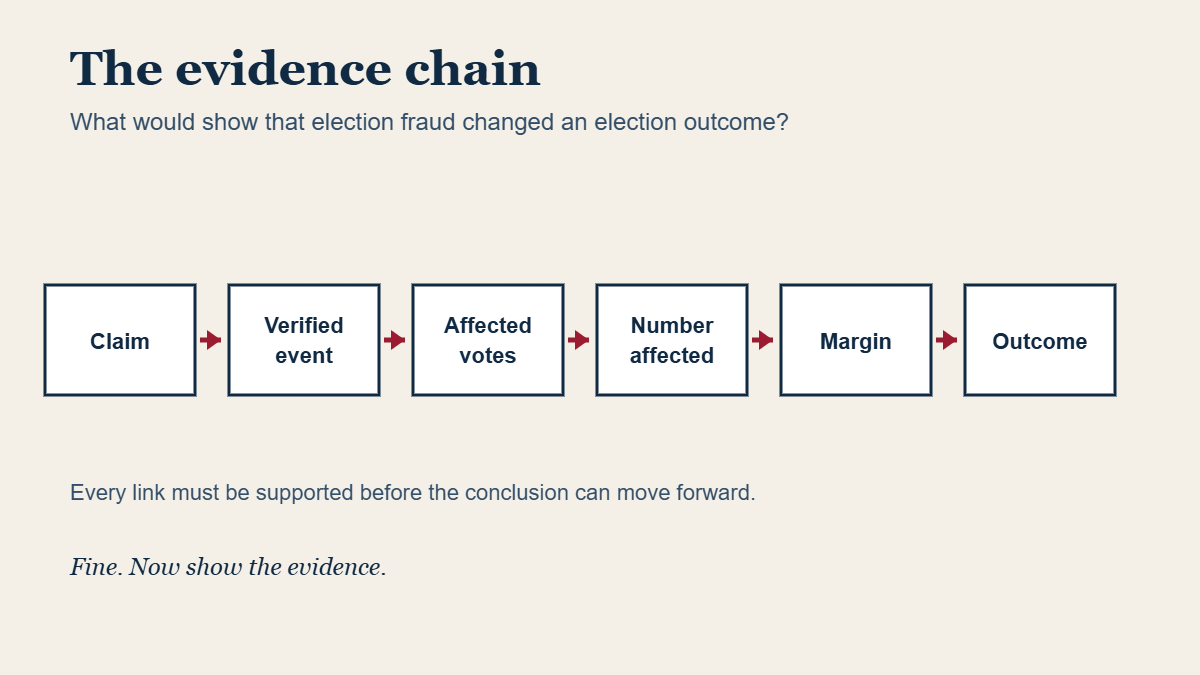
- Changed election outcome: evidence shows the successful exploitation changed enough valid votes to alter the certified result.
Those are different evidentiary steps. Skipping from the first or second directly to the fifth is not justified without additional proof.
Any claim built on 2020 election evidence therefore has to identify which of those steps the underlying records actually establish.
That is the same evidence standard used in How We Verify Claims: define the claim precisely, find the strongest available records, preserve context, and state what the evidence does not establish.
So do the new files prove the 2020 election was stolen?
No. Based on the public 2020 election evidence reviewed here, the new releases add evidence about vulnerabilities, threat capabilities, and the seriousness of election-security risks. They do not, by themselves, establish that vote totals in the 2020 U.S. presidential election were secretly changed or that the certified outcome was wrong.
That conclusion could change if new evidence establishes a specific intrusion, a successful manipulation, altered vote totals, and an effect large enough to change a state’s or the national result. That is the evidence threshold that would matter.
Why the new releases still matter
They matter because election-security claims should not be reduced to two slogans: either “the systems are perfectly secure” or “any vulnerability proves the election was stolen.” Both are too broad.
The evidence supports a more careful position: election systems can have real vulnerabilities, those vulnerabilities deserve aggressive mitigation and transparency, and claims that an election result was changed still require proof that the vulnerability was actually exploited in a way that altered votes.
Sources
- White House — Election Integrity
- Office of the Director of National Intelligence — Foreign Threats to the 2020 U.S. Federal Elections
- DOJ/DHS — Joint Statement on Foreign Interference in the 2020 Election
- Justice Department records concerning Attorney General Barr and the 2020 election
Evidence status: MIXED. The new releases support claims that meaningful election-system vulnerabilities and foreign capabilities existed. They do not establish that those vulnerabilities were used to change enough 2020 votes to alter the presidential outcome.
Fine. Now show the evidence.
How we rate claims: See the Evidence Matters Verdict System