
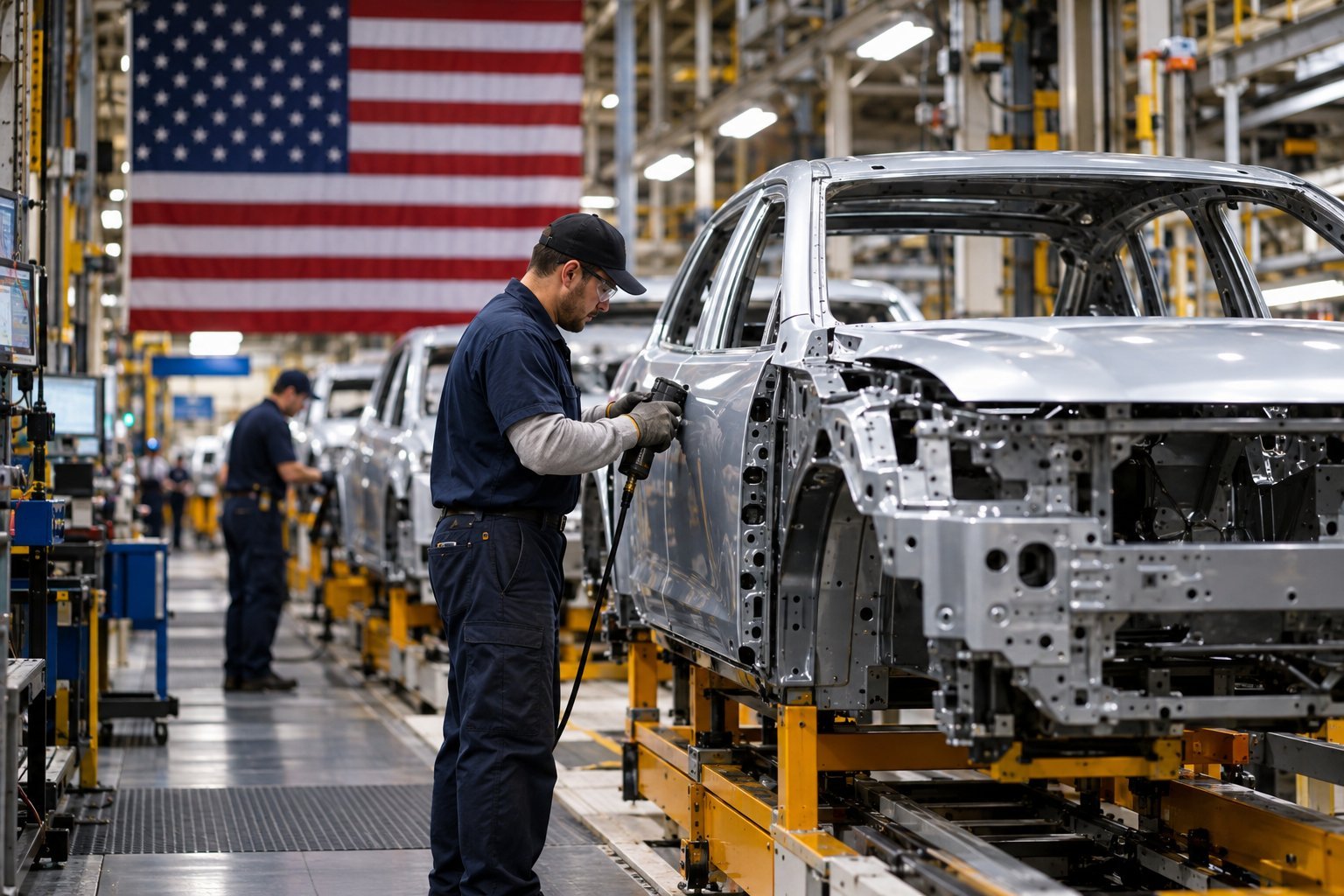
Trump auto factory tariff claims: what can be verified?
What Trump claimed
Trump auto factory tariff claims should be measured against documented plant openings and construction dates, not just investment announcements.
At a June 23, 2026, appearance at a Mack Trucks facility in Pennsylvania, Trump claimed that factory construction — including car factories and other industries — was running at three times any previous level, and attributed the increase to tariffs.
In that June statement, Trump grouped car factories with AI factories and other facilities when making the three-times comparison. Later in the same speech, he separately claimed that more auto plants were being built than at any point in 60 years, possibly ever. Neither claim supplied a consistent, independently verifiable factory inventory. The three-times comparison concerned factories overall, while the later claim specifically concerned auto plants; they should not be conflated.
Those are measurable historical claims. They require more than a list of investments or a favorable anecdote.
Source: June 23 speech transcript, Roll Call Factbase.
The U.S. did build automobile plants in previous decades
Any suggestion that the country went roughly four decades without building automobile assembly plants conflicts with automakers’ documented histories.
Honda’s 2026 manufacturing factbook dates production at its Marysville, Ohio, vehicle plant to November 1982 and its East Liberty, Ohio, plant to December 1989. Toyota’s own history also traces substantial American assembly investment over multiple decades.
These are direct corporate records, not estimates based on political affiliation. They refute an absolute claim that no such factories were built for decades. They do not, by themselves, establish exactly how many factories are under construction in 2026.
Sources: Honda 2026 North American manufacturing factbook; Toyota’s U.S. manufacturing history.
Documented new assembly plants before the current tariffs
These examples are distinct vehicle assembly facilities, not simply added shifts or model changes at older plants. They are examples, not an exhaustive national count.
| Plant | State | Milestone | Evidence |
|---|---|---|---|
| Kia West Point | Georgia | Opened 2010 | Kia opening announcement |
| Volkswagen Chattanooga | Tennessee | Opened 2011 | Volkswagen factory timeline |
| Toyota Blue Springs | Mississippi | Began Corolla production in November 2011 | Toyota production announcement |
| Volvo Charleston | South Carolina | Inaugurated June 2018 | Volvo announcement |
| Mazda Toyota Huntsville | Alabama | Production began 2021 | Toyota manufacturing history |
| Hyundai Metaplant | Georgia | First vehicle produced October 3, 2024 | Hyundai official manufacturing announcement |
One current construction example: Scout Motors’ South Carolina assembly facility was under construction in 2026, but South Carolina announced the project in March 2023. Scout Motors’ September 2026 construction update confirms construction and production-readiness work continued that year. The project’s original 2023 announcement predates the current tariff policies, so its existence alone cannot establish that those policies caused the project.
These dated examples undermine any suggestion that the United States stopped opening automobile assembly factories for decades. They do not constitute a complete count of projects under construction today or prove how construction rates compare across different presidential terms.
What the administration can point to
The White House published an August 19, 2026, summary describing investments and production changes by Ford, Toyota, Honda, GM, Mercedes-Benz, Stellantis, Hyundai, and other manufacturers. Those announcements deserve to be examined, not dismissed.
But the examples involve different kinds of activity: expanding existing plants, reallocating models to plants already in operation, increasing capacity, and planned investment. These are important economic decisions. They are not interchangeable with opening an entirely new vehicle assembly factory.
The administration attributes much of that activity to its trade policy. Some company statements also cite tariff incentives. A defensible analysis should acknowledge that evidence without assuming tariffs caused every investment.
Source: White House, August 19, 2026.
Five different stages that should not be counted as one
- Announced: A company promises or proposes investment.
- Financed and approved: Major funding and permits are secured.
- Under construction: Physical building or conversion is underway.
- Operating: A completed facility is actually producing vehicles.
- Expanded or retooled: An existing plant gains a shift, new models, or additional capacity.
A battery factory also should not be described as a new vehicle assembly plant without explanation. Counting an announcement, an expansion, and a new assembly site as three equivalent factories would mislead readers.
Do tariffs explain the investments?
Some automakers have discussed tariffs as a reason to increase U.S. production or adjust sourcing. Reuters reported in April that manufacturers were planning billions in U.S. investment while seeking clarity about future trade rules. That supports the narrower claim that tariffs can influence where companies plan production.
It does not establish the stronger claim that tariffs alone created a record-setting boom in entirely new automobile factories. Automakers plan factories over years, and announcements can reflect prior decisions, consumer demand, labor costs, technology changes, incentives, and trade policy together.
Source: Reuters, April 1, 2026.
What would establish a historical record?
A strong comparison needs a dated inventory of U.S. vehicle assembly factories, separated by new construction versus expansions, with consistent definitions across administrations and decades. It also needs counts of completed plants, not just proposed investments, and evidence linking each individual decision to tariffs where possible.
A list of press releases is not that inventory. Neither is the fact that one company added production at an existing facility.
Related TEM evidence checks
For readers weighing promises against measured outcomes, see Trump administration results: promises and measurable outcomes and Trump second term: evidence, outcomes, and what remains uncertain. These are broader policy evaluations; the factory examples in this article answer a narrower manufacturing claim.
Why factory opening dates matter when judging tariff claims
A new plant’s first vehicle is evidence that the facility became operational, but it does not reveal when managers first decided to build it. Major assembly sites take years to plan, permit, construct, equip, staff, and certify. That makes the chronology of the investment decision an essential part of testing any claim that a particular tariff policy caused a factory to exist.
The Hyundai Georgia facility illustrates the distinction: the company announced its investment plans in 2022, while the first production vehicle arrived in October 2024. The two dates describe different milestones. Counting the plant’s opening as evidence of a later tariff policy would confuse a completed construction project with its original cause. Similarly, Scout Motors’ South Carolina project was announced in March 2023 and remained under construction in 2026. Ongoing construction is real, but it is not automatically a new investment decision made in 2026.
There is also a difference between the number of buildings and the amount of domestic manufacturing. Expanding an existing factory can create jobs and raise American vehicle output without opening a new assembly facility. Conversely, a highly automated new facility may not employ the same number of workers as an older plant. Evaluating jobs, production capacity, investment, and newly constructed assembly sites requires separate measures, rather than treating each announcement as one identical achievement.
The fair test is straightforward: name the facility, document when it was committed and when it began producing vehicles, classify whether it is new or expanded, and cite the company’s explanation for its decision. Only then should anyone assign credit for a policy or claim a historical record.
Questions about Trump auto factory tariff claims
Does an announced investment mean a factory is open?
No. An announced project can still require permits, financing, construction, equipment installation, hiring, and testing before producing vehicles. A claim about factories being built is different from a claim about plants already operating. For that reason, this analysis identifies opening dates separately from announcements and ongoing construction.
Does a plant opening prove tariffs caused it?
Not by itself. The investment agreement and the initial site selection may precede the tariff policy by several years. Corporate statements explaining the decision, paired with a dated project timeline, provide stronger evidence of causation than an opening ceremony alone. The Hyundai Georgia and Scout Motors examples show why the announcement and operational dates must remain separate.
What would demonstrate a threefold factory-construction increase?
Researchers would need a consistent count of newly constructed facilities during equivalent time periods, the same definition of a factory across both periods, and a documented baseline. Announced investments, added shifts, battery projects, existing plant expansions, and operating vehicle assembly sites cannot simply be added together as if they represented the same measurement. This article has not established such a nationwide comparison.
How to compare factory-construction claims fairly
Before comparing one presidential term with another, researchers must define which facilities count. A completed vehicle assembly plant is different from a battery plant, an engine factory, or a new production line within an existing building. All can involve significant investment, but mixing them makes the resulting factory total impossible to interpret. For an apples-to-apples comparison, every entry should describe the same class of facility.
The time period matters just as much. A company might announce a factory during one administration, break ground during another, and begin production during a third. Assigning all three milestones to the inauguration-year president obscures who approved the project, when construction began, and when workers started producing vehicles. A sound inventory should record each milestone independently, rather than choose the date that produces a favored political conclusion.
Investment dollars also cannot substitute for a count of factories. A manufacturer can spend billions updating a plant without adding another assembly site. Another can build a new plant with a smaller investment. Employment and output deserve their own comparisons: a plant opening does not automatically establish how many net manufacturing jobs or vehicles the nation gained, particularly if production shifts away from another U.S. location.
Finally, a historical superlative requires a historical baseline. To establish a threefold increase, investigators need comparable counts for a defined current period and a defined earlier period, then a transparent calculation. The present sample demonstrates actual factory openings long before the current tariffs, but it is not a complete national database. That limit is why the sweeping numerical claim remains unsubstantiated here—not why every announced investment should be disregarded.
What the evidence shows
Supported: Automakers have announced investments, expansions, and production shifts in the United States. Some explicitly discuss tariffs as a factor.
Contradicted: A categorical claim that the United States went decades without opening car assembly plants.
Unsubstantiated by the records reviewed: That today’s rate of construction of entirely new automobile assembly plants exceeds the historical record, or that tariffs alone caused the investments. Trump’s three-times comparison covered factories more generally; this automobile-focused inventory cannot independently resolve it.
This matters because workers and communities deserve credit for real investment without having to accept an exaggerated comparison.
Fine. Now show the evidence.
How we rate claims: See the Evidence Matters Verdict System