
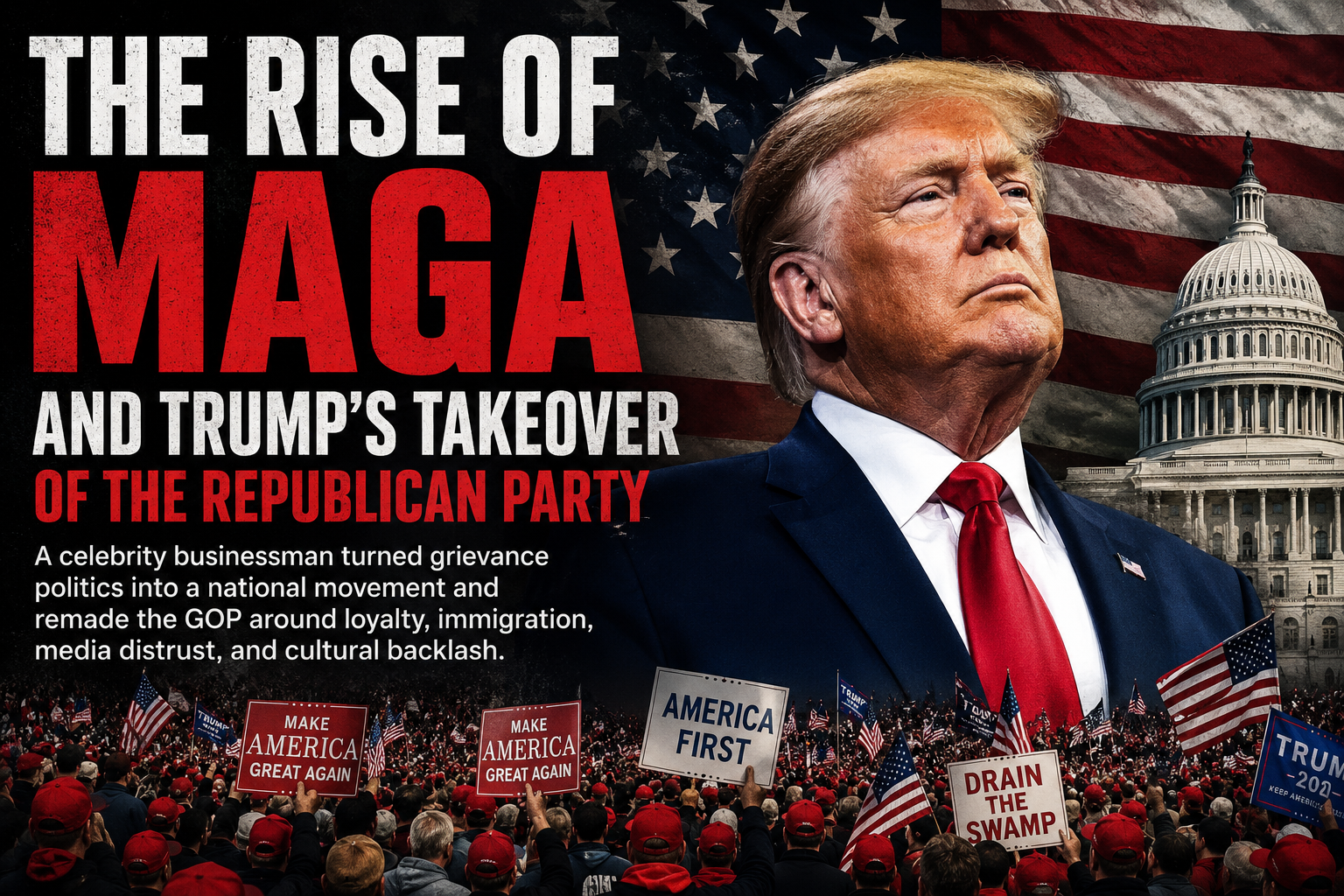
Donald Trump did not just win a Republican primary. He changed what the Republican Party rewarded. The rise of MAGA turned grievance politics into a national movement and remade the GOP around loyalty, immigration, media distrust, and cultural backlash.
The rise of MAGA is one of the biggest stories of modern American politics because it was not only about Trump becoming the Republican nominee.
It was about the Republican Party changing around him.
Before Trump, Republican leaders usually framed the party around limited government, tax cuts, free markets, military strength, religious conservatism, and constitutional principles.
Trump shifted the center of the party toward something more personal and emotional. The new test was not policy knowledge. It was loyalty. It was combat. It was whether a politician sounded like they were fighting the same enemies Trump named.
The rise of MAGA succeeded because it gave angry voters a story, a leader, and a list of enemies.
The Rise of MAGA Was Already Building
Trump launched his campaign at Trump Tower on June 16, 2015. The image of the escalator became famous, but the anger he tapped into already existed.
Many Republican voters were frustrated with Washington, suspicious of immigration, hostile toward the press, and tired of establishment politicians who promised big changes but delivered the same old fights.
Trump did not invent those feelings. He organized them.
He gave voters permission to treat resentment as patriotism.
Grievance Became the Message
MAGA politics was built around a simple claim:
America was being taken from you.
That message turned complicated issues into easy targets. Immigrants became an invasion. Journalists became enemies. Experts became elitists. Diversity became a threat. Courts became corrupt when they ruled against Trump. Elections became rigged when he lost.
The power of the message was not that it explained the world accurately. It was that it explained the world emotionally.
MAGA did not ask supporters to prove the story. It asked them to feel it.
Immigration Was the Emotional Engine
Immigration was the issue that made MAGA feel urgent.
The wall was more than a policy proposal. It was a symbol. It told supporters that Trump would draw a line, protect their version of America, and punish the leaders they believed had let the country change too much.
That is why the border remained central even when details changed, promises were not fully kept, or results were more complicated than the slogans.
MAGA did not need immigration to be a complete policy plan. It needed immigration to be a story about loss, fear, and control.
Media Distrust Became a Defense System
Trump’s attack on the press was one of the most important parts of the takeover.
Calling critical coverage fake news did more than discredit individual stories. It trained supporters to reject outside information before they even heard it.
If reporting hurt Trump, it was fake. If a fact check exposed him, it was biased. If a Republican official contradicted him, that person became a RINO.
That created a closed information loop. Trump made the claim. MAGA media repeated it. Supporters believed it. Any outside correction became proof that the system was against him.
Once evidence came from outside the movement, MAGA could dismiss it without answering it.
The GOP Became a Loyalty Party
Trump’s real victory was not only winning the nomination. It was forcing Republican leaders to adapt to him.
Many Republicans who once criticized Trump later defended him. Some stayed quiet. Others copied his style. They learned that crossing him could end a career, while defending him could protect one.
This changed the party’s standards.
Character mattered until Trump’s character became inconvenient. Deficits mattered until Republican power required ignoring them. Law and order mattered until January 6 defendants became part of the movement’s mythology.
The new rule was simple:
- Defend Trump.
- Attack his critics.
- Reject damaging evidence.
- Call disloyal Republicans weak or corrupt.
Why Republican Leaders Let It Happen
The Republican establishment did not stop MAGA because it needed MAGA.
Trump brought attention, turnout, small dollar donations, media dominance, and a loyal base. Republican leaders wanted judges, tax cuts, power, and control of government.
So they made the bargain.
They accepted the lies because the lies came with votes. They accepted the chaos because the chaos came with power. They accepted the personality cult because it kept their voters engaged.
That bargain changed the party.
Cultural Backlash Was the Fuel
MAGA was never only about economics.
It was also about identity, status, race, religion, gender, education, cities, protest, and who gets to define what America is.
Trump told supporters they were the real Americans. That made political disagreement feel like a fight over belonging.
Once politics became a battle between real Americans and enemies, compromise became weakness and evidence became optional.
Why the Rise of MAGA Matters
The rise of MAGA matters because it explains what came later.
The Big Lie did not appear out of nowhere. January 6 did not come from nowhere. The fake elector plot did not come from nowhere. The attacks on courts, prosecutors, election workers, and journalists did not come from nowhere.
They came after years of teaching voters that Trump’s enemies were corrupt and that only Trump could be trusted.
Once a party accepts that logic, evidence loses its power.
The rise of MAGA was the moment loyalty began replacing evidence inside one of America’s two major parties.
The Bottom Line
Trump did not take over the Republican Party by offering a better governing philosophy.
He took it over by understanding the base better than the party leaders did.
He turned grievance into identity. He turned immigration into a symbol of national decline. He turned media distrust into protection. He turned cultural backlash into a movement. And he turned Republican politics into a loyalty test.
The rise of MAGA was not just Trump changing the GOP. It was the GOP deciding that power was worth the price.
That is why this story belongs at the beginning of any serious history of the MAGA era.
Sources and Further Reading
- American Presidency Project: Trump’s 2015 Campaign Announcement
- Pew Research Center: Republican Voters’ Path to Backing Donald Trump
- Pew Research Center: Trump Supporters and Immigration Attitudes
- Gallup: Americans’ Views of the News Media
- Voter Study Group: Race, Religion, and Immigration in 2016
- Related: What MAGA Wanted Trump’s Legacy To Be vs. What History May Actually Remember
How we rate claims: See the Evidence Matters Verdict System