
Short answer: Proving that election fraud occurred is not the same as proving election fraud changed who won. A persuasive outcome-changing claim needs evidence connecting a specific unlawful act to identifiable ballots or votes, the number affected, the contest affected, and an effect large enough to matter under the applicable jurisdiction’s rules.
This page is an evidence framework, not a conclusion about any particular election. Election-contest procedures, burdens of proof, recount rules, deadlines, and remedies differ by state and jurisdiction.
What evidence would show election fraud changed the outcome?
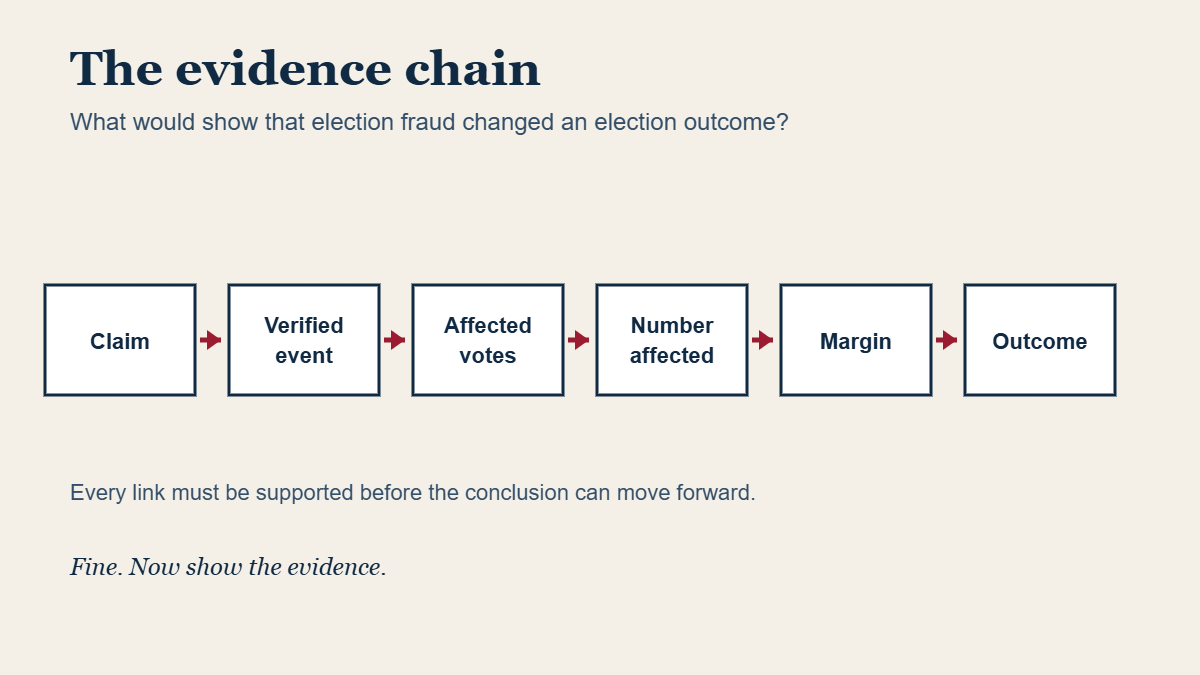
A useful way to test whether election fraud changed the outcome is:
Claim → verified event → affected ballots or votes → number affected → contest affected → margin → demonstrated effect on the outcome.
Every link matters. If the evidence does not establish that election fraud changed the outcome, the conclusion should stop where the evidence stops.
Start with the exact claim
These statements are not interchangeable:
- A voting system had a security vulnerability.
- An election worker violated a procedure.
- An ineligible person appeared on a voter-registration list.
- An ineligible person actually cast a ballot.
- Illegal ballots were counted.
- The number of affected votes exceeded or placed the winning margin in doubt.
- Election fraud changed the winner.
Each step requires additional evidence. A vulnerability can establish risk or capability; it does not by itself establish exploitation. A registration problem does not by itself establish that a ballot was cast. A proven illegal vote establishes more, but one illegal vote in a contest decided by thousands does not establish that the wrong candidate won.
Why the margin matters
Consider a fictional election in which Candidate A receives 510,000 votes and Candidate B receives 490,000. The margin is 20,000 votes.
If investigators conclusively establish 200 illegal votes, that finding matters. It may warrant investigation, prosecution, correction, or another remedy depending on the facts and applicable law. But 200 affected votes, standing alone, do not establish that a 20,000-vote margin was wrong.
Now consider a contest decided by 75 votes where reliable evidence establishes 300 outcome-relevant ballots were unlawfully added, removed, altered, or improperly counted. The relationship between the evidence and the reported result is materially different. The legal remedy still depends on the jurisdiction, but the demonstrated number of affected votes is now large enough to put the reported margin at issue.
Fraud can be real without changing the winner
Suppose investigators prove that somebody intentionally cast five fraudulent ballots. Then election fraud occurred. That should not be minimized.
But if the contest was decided by 50,000 votes, those five ballots do not establish that election fraud changed the winner.
That is why two separate questions must be asked:
- Did election fraud occur?
- Did the evidence show that election fraud changed the outcome, or created legally significant uncertainty about it?
The answer to the first question can be yes even when the evidence does not establish that election fraud changed the outcome.
A voting-system vulnerability is not automatically evidence votes were changed
Security vulnerabilities deserve investigation and mitigation. But the existence of a vulnerability establishes something different from proof that somebody exploited it in a particular election.
Compare these propositions:
- The system could be compromised.
- The system was compromised.
- It was compromised during this election.
- The compromise altered recorded votes.
- Enough votes were altered to affect this contest.
Each proposition requires additional evidence. Depending on the allegation, investigators might look for logs, configuration changes, unauthorized access, forensic artifacts, altered records, discrepancies between voter-verifiable paper records and electronic totals, or other independently verifiable indicators.
The U.S. Election Assistance Commission similarly distinguishes identified vulnerabilities from evidence that a particular voting system was affected. See the EAC’s voting-system vulnerability guidance.
Registration problems are not automatically illegal votes
The same discipline applies to voter-registration allegations.
- A database flags someone as potentially ineligible.
- An ineligible person is actually registered.
- That person receives or requests a ballot.
- That person returns a ballot.
- The ballot is accepted and counted.
- The vote affects a particular contest.
A match or flag may justify investigation, but it does not automatically establish every later step. Conversely, reliable evidence that an ineligible person actually cast an unlawful ballot should be evaluated for exactly what it proves.
What an audit can prove
Post-election audits test election results and processes. The National Conference of State Legislatures explains that post-election audits generally examine whether voting equipment and procedures accurately recorded and counted votes, while the precise method and requirements vary by state.
Risk-limiting audits are designed to provide statistical evidence about whether a reported outcome is correct and can escalate when the available evidence is not sufficient.
Before saying an audit proved or disproved an allegation, ask what the audit actually tested: which contests, which ballots, what sample or method, what discrepancies were found, and what the jurisdiction’s rules require when discrepancies appear.
See NCSL’s overview of post-election audits.
What a recount can prove
A recount generally retabulates ballots to determine whether the original count accurately reflected the votes recorded on those ballots. Recount triggers and procedures differ by jurisdiction.
A recount can provide strong evidence about tabulation. But it does not necessarily resolve allegations outside the recount’s scope—for example, a claim that ballots should not have existed in the first place.
See NCSL’s summary of state recount laws.
What certification means
Election-night totals are unofficial. Election officials continue processing eligible ballots, reconciling records, canvassing results, and carrying out the post-election procedures required by their jurisdiction before certification.
The Election Assistance Commission describes canvassing, certification, audits, and recounts as distinct post-election processes, with rules and timing varying across jurisdictions. Certification is important evidence of the official result, but it should not be overstated as proof that no error or unlawful conduct could possibly have occurred. Likewise, an identified error or unlawful act does not by itself prove that election fraud changed the outcome or that certification named the wrong winner.
See the EAC’s canvass and certification guidance.
What stronger evidence looks like
- original ballots or voter-verifiable paper records;
- official election records and authenticated database records;
- system logs and forensic evidence;
- documented chain-of-custody records;
- audit findings and recount results;
- sworn testimony supported by independent records;
- authenticated surveillance or contemporaneous records;
- criminal investigative evidence;
- court findings after evidence has actually been tested; and
- multiple independent sources establishing the same underlying event.
The important characteristic is not that evidence looks dramatic. It is that it can be authenticated, examined, independently checked, and connected to the proposition being asserted.
Evidence that may justify investigation without proving the larger claim
Some information can be relevant without establishing the conclusion by itself. Examples include anonymous posts, cropped videos without full context, unexplained statistical anomalies, database matches, secondhand reports, demonstrations of what a system could theoretically do, or estimates whose assumptions have not been independently verified.
Not proven does not necessarily mean false. It means the available evidence has not established that proposition.
Witnesses and affidavits
Witness testimony is evidence, but testimony should be evaluated according to what the witness actually observed and what can be corroborated.
For example, “I saw workers carrying boxes into a counting room” is an observation. “Those boxes contained thousands of fraudulent ballots” is a separate proposition requiring evidence about what was in the boxes.
A credible observation should not be discarded. An inference should not automatically be converted into an established fact.
Courts matter—but read what the court actually decided
A court can dismiss or reject an election case for different reasons, including standing, jurisdiction, timeliness, pleading deficiencies, evidentiary problems, failure to satisfy a legal standard, or a decision on the merits. Those are not interchangeable outcomes.
When citing a court decision, ask what question was before the court, what evidence was actually considered, what factual findings were made, what legal standard applied, whether the ruling was procedural or merits-based, and what remedy was requested.
A practical election-evidence checklist
- What exactly is the allegation? Reduce it to a testable sentence.
- What is the original evidence? Find the underlying record rather than commentary about it.
- Can it be authenticated? Establish where it came from and whether its integrity can be checked.
- What does it directly prove? Separate observation, inference, capability, and demonstrated event.
- How many ballots or votes are demonstrably affected?
- Which contest did they affect?
- What was the margin?
- What did audits, recounts, canvassing, or other verification procedures actually examine?
- Has the evidence been independently corroborated?
- What remains unresolved? State uncertainty rather than filling it with assumptions.
The standard should not change with the candidate
The same evidentiary rules should apply regardless of the candidate, party, election official, commentator, or voter making the allegation.
Evidence supporting a claim should be acknowledged. Evidence contradicting it should also be acknowledged. Mixed evidence should be described as mixed. When the record cannot resolve the claim, the appropriate status is unresolved.
That is the same approach described in How We Verify and used in the site’s Verify a Claim reviews.
The bottom line
Election fraud and an outcome-changing fraudulent election are related claims, but they are not identical.
Evidence of an illegal vote matters. Evidence of a voting-system vulnerability matters. Evidence that procedures were violated matters. None should be ignored.
But none automatically proves that the wrong candidate was declared the winner.
For the stronger conclusion, keep following the chain: What happened? What proves it? How many votes were affected? Which contest did they affect? How does that number compare with the margin? What do the applicable verification procedures and legal standards establish?
Follow the evidence as far as it goes. Then stop where the evidence stops.
Fine. Now show the evidence.
Related Evidence Matters resources
- How We Verify
- Verify a Claim
- Trump’s Election-Integrity Speech: What the Evidence Shows
- The 10K Truth Challenge
How we rate claims: See the Evidence Matters Verdict System