
Epstein Files: Evidence, Speculation, and Public Trust
Epstein files became more than court documents. They became a public test of whether powerful people are held accountable the same way everyone else is.
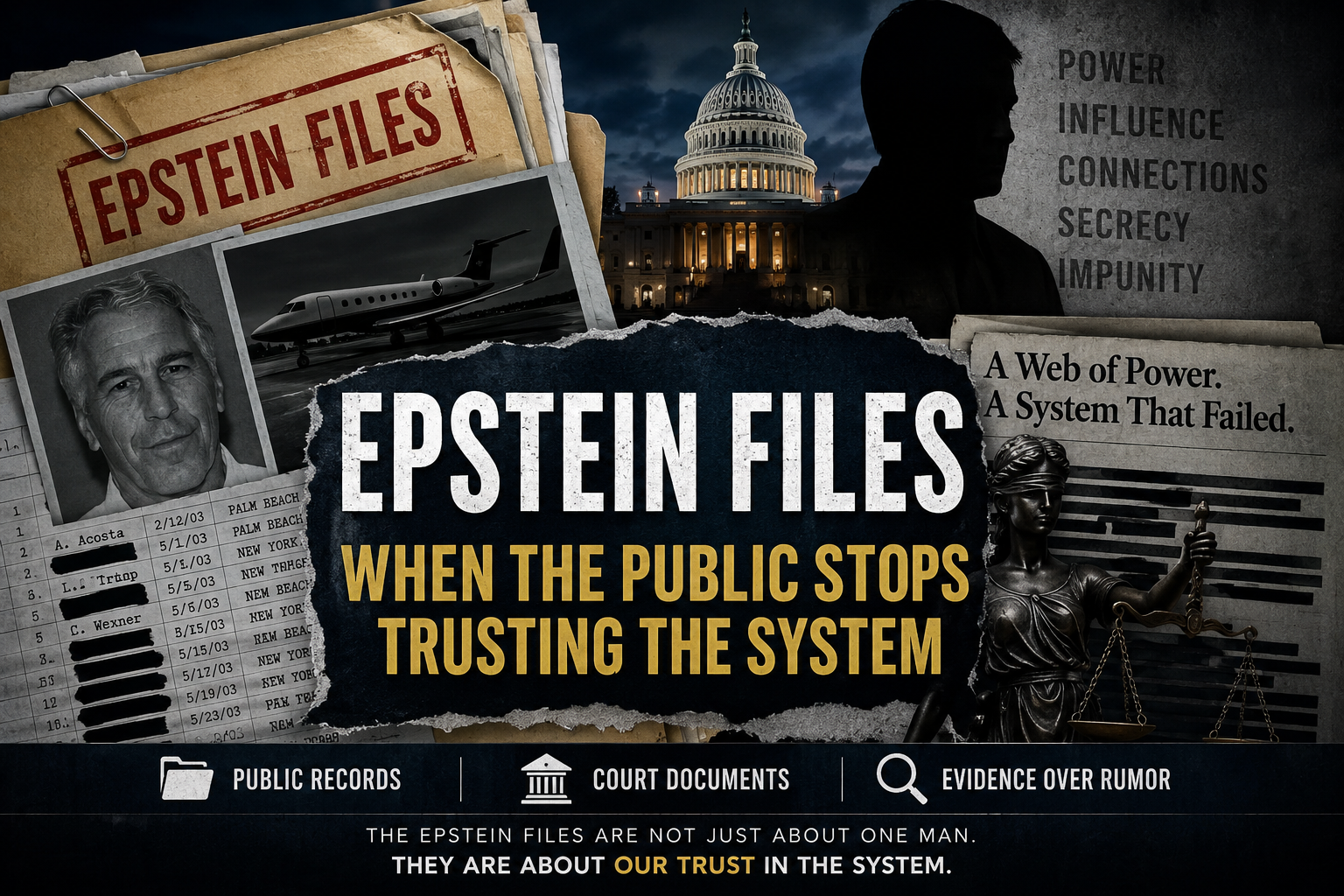
The public obsession with the Epstein files is not really about curiosity anymore. It is about trust.
Trust in government. Trust in the justice system. Trust in media. Trust that powerful people are held accountable the same way ordinary people are.
That trust was already weak before Jeffrey Epstein entered the national spotlight. His case just poured gasoline on it.
Americans watched a wealthy, politically connected man receive an unusually favorable plea deal in 2008 after serious allegations involving minors. Then, years later, they watched him get arrested again on federal charges, only to die before trial while sitting in federal custody.
From that point forward, the Epstein case stopped being just a criminal case. It became symbolic.
Why the Epstein Files Matter to So Many Voters
The phrase Epstein files has become shorthand for something much bigger than court documents.
To many Americans, it represents the suspicion that there are two justice systems.
- One for ordinary people
- Another for wealthy and politically connected elites
That suspicion did not appear out of nowhere.
Epstein had documented connections to politicians, celebrities, billionaires, academics, and royalty. Photographs, flight logs, contact books, and witness testimony showed he moved comfortably inside elite circles for years.
Then came the obvious public question:
If Epstein was guilty, who else knew what was happening?
That question still drives enormous public interest today.
The Internet Made the Epstein Files Even Harder to Understand
The internet did not just spread information about the Epstein files. It blurred the line between evidence and speculation.
Real court filings became mixed with edited screenshots, fake client lists, viral rumors, political spin, and conspiracy theories.
Some people online now treat every name mentioned in Epstein related documents as automatically guilty. That is not how evidence works.
Appearing in a contact book, photograph, flight log, party invitation, or deposition is not automatically proof of criminal conduct.
But the opposite problem also exists. Many Americans feel institutions spent years minimizing legitimate concerns surrounding Epstein and his connections. That created an environment where people became more willing to believe almost anything.
The Political Double Standard Around the Epstein Files
One of the most revealing parts of the Epstein discussion is how political tribes react differently depending on whose name appears in the story.
Conservatives often focus on figures connected to Democrats. Liberals often focus on figures connected to Republicans.
The evidence itself becomes secondary to whether the accusation helps or hurts someone’s political team.
That is dangerous.
Evidence should not change based on party affiliation.
If someone demands strict evidence standards for accusations against their allies but accepts weak evidence against opponents, they are not really defending truth. They are defending a team.
The Bigger Issue Is Institutional Failure
The most important lesson from the Epstein case may not be about individual names at all.
It may be about what happens when public institutions lose credibility.
Once people stop believing government agencies are honest, media organizations are fair, the justice system applies equally, and powerful people face accountability, the vacuum gets filled with speculation.
Some of that speculation may point toward legitimate unanswered questions. Some becomes fantasy.
The problem is that when institutional trust collapses badly enough, many people stop distinguishing between the two.
Why Evidence Still Matters in the Epstein Files
None of this means people should blindly trust institutions.
Skepticism is healthy. Demanding transparency is healthy. Asking difficult questions is healthy.
But evidence still matters.
Real evidence. Not screenshots with no source. Not viral memes. Not edited clips. Not anonymous lists floating around social media.
The Epstein case should remind people of two things at the same time.
- Powerful institutions can fail spectacularly
- Claims still require evidence before they should be accepted as true
Losing sight of either principle creates a different kind of danger.
How we rate claims: See the Evidence Matters Verdict System