
11 Years of Debating Trump Supporters and One Question They Still Avoid
Political debate evidence matters because real debates require proof, consistency, and accountability. After more than a decade of arguing online with Trump supporters, one pattern keeps repeating itself. The arguments never stop, but the evidence never arrives.
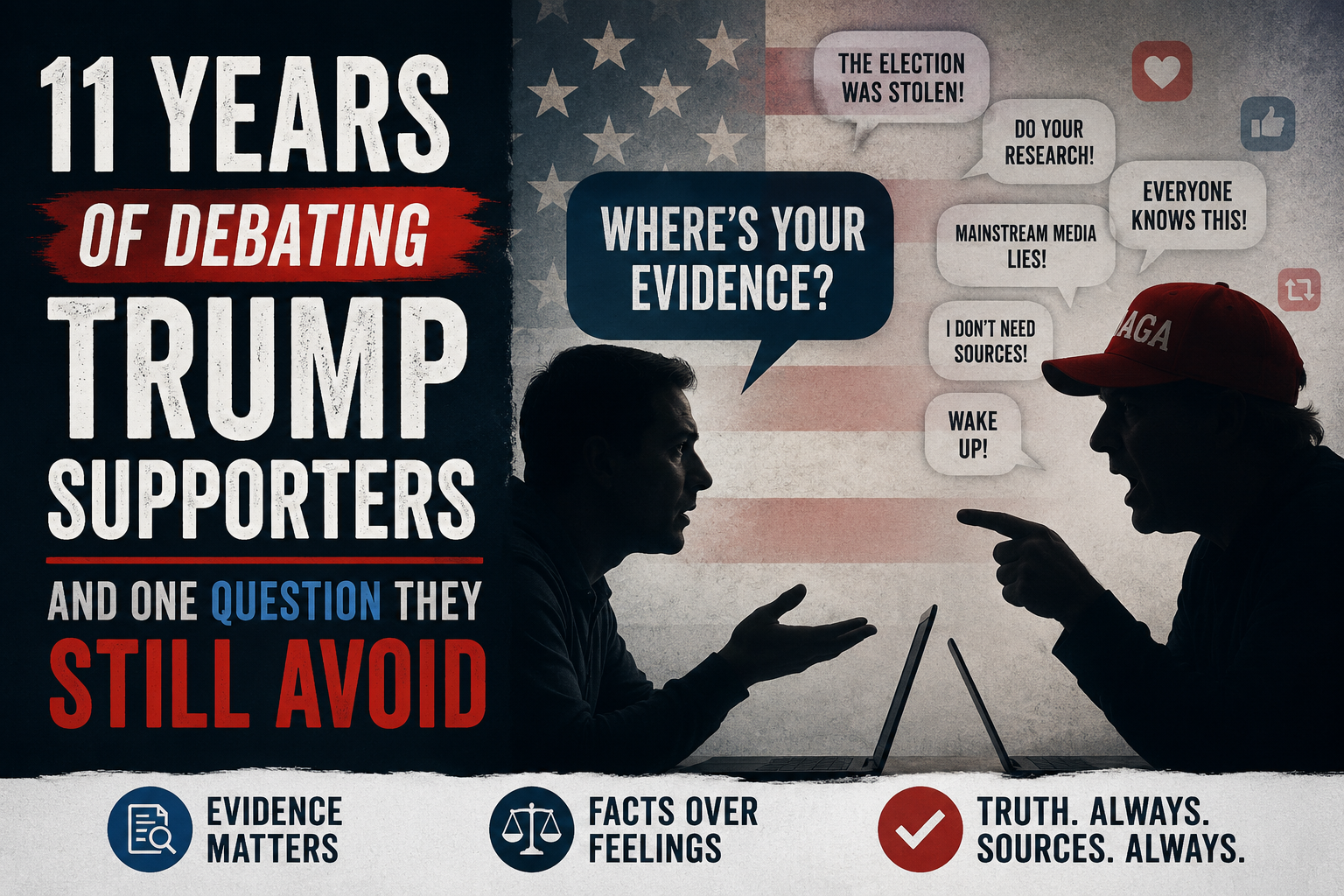
Political Debate Evidence Should Matter More Than Team Loyalty
I have been debating Trump supporters online for about 11 years now. Over that time, I noticed something strange. The same people keep returning to argue, even after they fail to provide evidence for their claims.
They come back day after day. Year after year. Election after election.
But when asked for proof, documents, court rulings, verified records, direct evidence, or even a consistent explanation, the conversation usually falls apart quickly.
Then something predictable happens. The subject changes. The standards move. A new accusation appears. Or the conversation turns emotional instead of factual.
That pattern says something important about modern political arguments online. A lot of these exchanges are not really debates in the normal sense. They are loyalty tests dressed up as arguments.
Why Political Debate Evidence Often Gets Ignored
Most people assume a debate is about discovering what is true. In reality, many online political arguments are about defending identity and loyalty.
When someone is emotionally attached to a political movement, criticism of that movement can feel personal. Evidence becomes secondary to protecting the group identity.
This is why some people can make large claims without evidence, ignore court rulings, shift arguments repeatedly, contradict earlier positions, and still return the next day as if nothing happened.
The goal often is not accuracy. The goal is defending the tribe.
How Online Political Arguments Changed After 2016
Before social media became fully political, most arguments online were shorter and less personal. People disagreed, but they were usually debating specific policies, candidates, or events.
After 2016, politics became more identity driven. Supporting Donald Trump often became tied to larger cultural frustrations involving media distrust, elite institutions, immigration, globalization, and anger toward political establishments.
That shift changed how many online debates worked. Critics were no longer seen as simply disagreeing about policy. They were often viewed as enemies attacking the group itself.
Once politics becomes identity based, evidence becomes much harder for people to accept. Facts that threaten the identity of the group are often rejected automatically, even when the evidence is publicly available.
Political Debate Evidence and the 2020 Election Claims
One of the clearest examples involved the 2020 election fraud claims.
Trump supporters repeatedly claimed the election was obviously stolen and that overwhelming evidence existed everywhere.
But years later, the same problem remains. Where is the evidence strong enough to survive scrutiny?
Courts rejected dozens of major election fraud cases. Trump administration officials, state election officials, cybersecurity experts, and judges appointed by both parties repeatedly stated there was no evidence of widespread fraud capable of changing the election result.
Yet many supporters still speak about the claim with total certainty. That tells you the belief is no longer operating on evidence alone.
Sources for the curious: Associated Press election coverage, Reuters Fact Check, U.S. Department of Justice
Why Some People Return to Arguments Without Evidence
One of the strangest parts of online political debates is how often people return after losing the factual argument.
In a normal discussion, failing to provide evidence would usually end the conversation. Online political spaces often work differently.
Confidence is rewarded more than accuracy. Repetition is rewarded more than verification. Loyalty is rewarded more than consistency.
This creates an environment where someone can repeatedly make claims without proof and still receive approval from their political community.
Social media algorithms also reward outrage and conflict because emotional engagement keeps people interacting longer.
That means calm evidence based conversations are often buried while emotionally charged content spreads faster.
The Real Audience in Political Debates
One lesson I learned after years of online arguments is this. You are usually not debating to convince the loudest person replying to you.
You are debating for the people silently reading the conversation.
Those quiet readers notice who provides evidence and who avoids it. They notice who answers questions directly and who pivots constantly.
Calm, evidence based responses often matter more than emotional shouting.
“If the evidence is overwhelming, why can nobody clearly present it?”
That question has been hanging over many political arguments for years now.
Political Debate Evidence Still Matters
Even when arguments feel repetitive or frustrating, political debate evidence still matters.
It matters for the silent readers watching the conversation. It matters for younger audiences learning how to evaluate claims. It matters for preserving an accurate public record.
Facts do not always change minds immediately, especially when emotions and identity are involved. But documented evidence still matters over time.
History usually judges political movements far more by evidence than by slogans.
Evidence Only Works When Both Sides Agree It Matters
This may be the biggest lesson from the last decade of political debate online.
Evidence only works when both sides agree evidence matters.
Without that shared standard, conversations become emotional contests instead of factual discussions.
That does not mean evidence becomes useless. It still matters for undecided readers, future accountability, searchable information, and separating facts from political mythology.
The point of evidence is not always to instantly change minds. Sometimes the point is simply to preserve reality before misinformation completely replaces it.
How we rate claims: See the Evidence Matters Verdict System