
7 Powerful Examples of Intellectual Inconsistency in Politics
intellectual inconsistency in politics happens when people demand evidence from opponents but accept excuses from their own side.
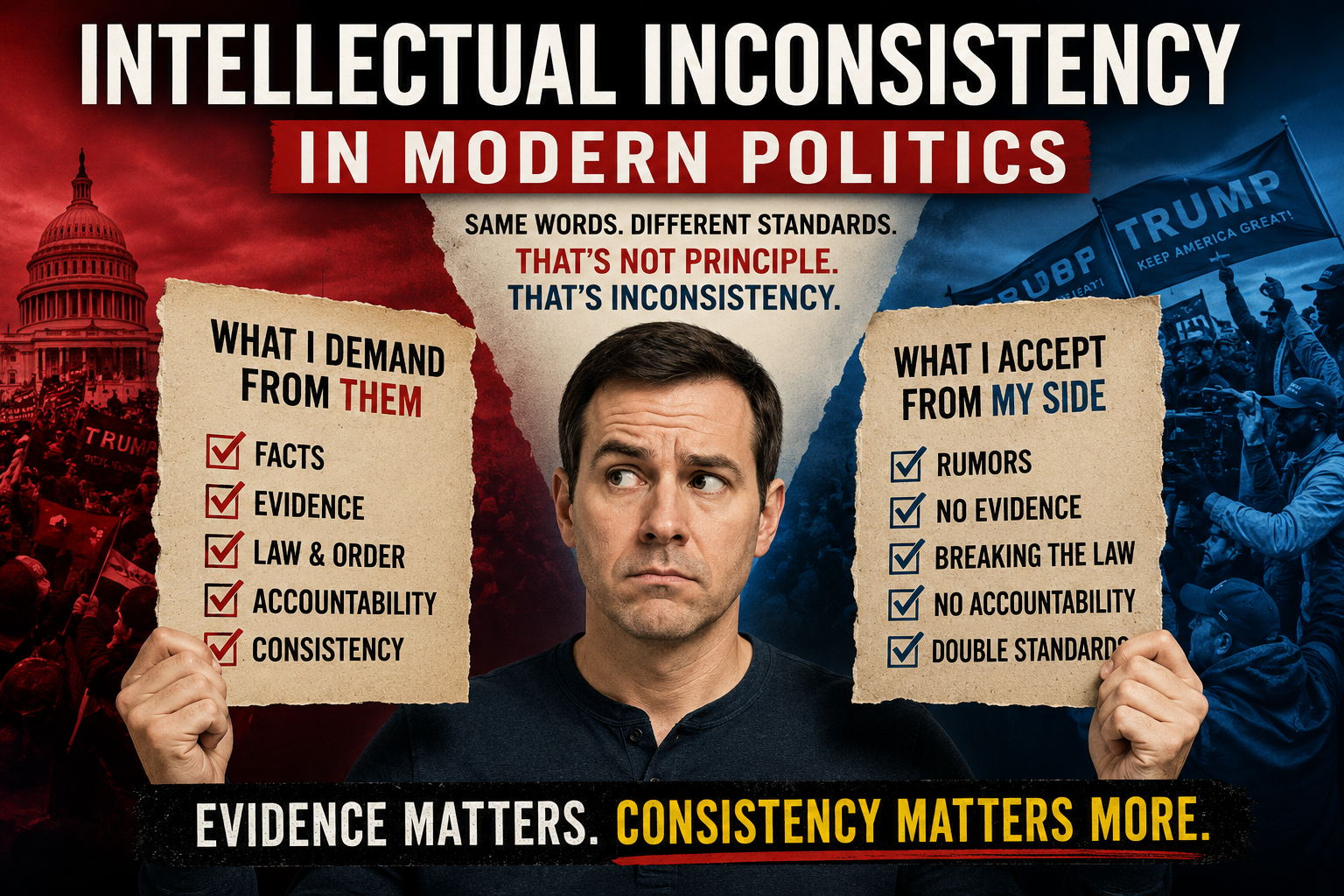
Intellectual inconsistency in politics is not limited to one party. It is a human problem. People are very good at spotting hypocrisy when it comes from opponents and very bad at admitting it when it comes from their own team.
Critics of MAGA often point to this pattern. Many supporters claim to care about law and order, free speech, constitutional rights, limited government, truth, and evidence. Those principles sound good. The problem starts when those same principles disappear the moment they become politically inconvenient.
The issue is not ordinary disagreement. The issue is selective standards.
What Intellectual Inconsistency in Politics Means
Intellectual inconsistency in politics happens when someone changes their reasoning depending on who benefits.
The same person may demand court records, documents, video, sworn testimony, and direct proof when a claim hurts their side. Then that same person may accept rumors, screenshots, influencer clips, anonymous posts, or “everybody knows” arguments when the claim helps their side.
That is not critical thinking. That is team loyalty wearing reading glasses.
A consistent standard asks the same basic questions every time:
- What is the claim?
- Who is making it?
- What evidence supports it?
- Would I accept this evidence if the other side used it?
- What would change my mind?
1. Law And Order, Except When It Is Their Side
“Law and order” has been one of the loudest slogans in modern conservative politics. Many MAGA supporters say they support police, criminal penalties, secure buildings, public safety, and respect for legal process.
Then came January 6.
Once the people charged were politically aligned with their movement, many of the same voices shifted from “back the blue” to “political prisoners.”
The standard changed because the identity of the accused changed.
2. Free Speech, Except For Speech They Dislike
Free speech is another principle many MAGA influencers claim to defend.
But free speech is not tested when people say things you already agree with. It is tested when people criticize your side, mock your leaders, challenge your beliefs, or publish facts that make your movement uncomfortable.
If someone supports free speech for allies but wants punishment, retaliation, banning, censorship, or government pressure against critics, that is not a free speech principle. That is preference.
3. Distrusting The Media While Trusting Worse Sources
Skepticism toward major media is fair. News outlets make mistakes. Headlines can be sloppy. Bias exists.
But rejecting every mainstream source while blindly trusting partisan influencers is not media literacy.
A source does not become trustworthy just because it sounds angry, says what people want to hear, or claims to be “telling the truth they do not want you to know.”
4. Small Government, Except When Government Targets Their Enemies
Limited government is supposed to mean the state should not control every part of private life.
Yet many people who claim to support limited government also support aggressive government action when it targets books, schools, protest movements, private companies, medical decisions, or speech they dislike.
5. Facts Over Feelings, Until The Facts Hurt
“Facts do not care about your feelings” became a popular slogan because it sounds tough.
The problem is that facts are only useful if people accept them when they are inconvenient.
Court rulings, official records, certified election results, sworn testimony, public documents, and direct evidence do not stop mattering just because they disappoint your political side.
6. Debt And Deficits, But Only Under Democrats
Federal spending, deficits, and national debt are legitimate issues.
The inconsistency appears when people treat debt as a national emergency under one party and barely mention it under the other.
7. Calling Other People Brainwashed While Repeating Unproven Claims
One of the stranger political habits is accusing opponents of being brainwashed while repeating claims that have never survived basic evidence review.
A suspicion is not evidence. A pattern is not proof. A viral claim is not a verified fact.
Why Smart People Still Fall For Intellectual Inconsistency in Politics
Intellectual inconsistency in politics does not only happen to uninformed people.
Smart people can be very good at defending bad arguments. Education, income, and confidence do not automatically protect anyone from motivated reasoning.
When politics becomes identity, evidence feels personal. A correction feels like an attack.
The Evidence Matters Standard
Apply the same test to everybody.
If a Democrat makes a claim, check the evidence. If a Republican makes a claim, check the evidence.
No side gets a loyalty discount.
Consistency means being willing to say, “My side is wrong,” when the record proves it.
FAQ: Intellectual Inconsistency in Politics
What is intellectual inconsistency in politics?
Intellectual inconsistency in politics happens when people apply different evidence standards depending on which political side benefits from the claim.
Why does intellectual inconsistency in politics happen?
Political identity, confirmation bias, motivated reasoning, and emotional loyalty can cause people to defend weak arguments from their own side while criticizing the same behavior from opponents.
Is intellectual inconsistency limited to one political party?
No. Intellectual inconsistency in politics can happen across the political spectrum whenever loyalty becomes more important than evidence.
Related Evidence Matters Pages
External Sources And Research
How we rate claims: See the Evidence Matters Verdict System