
Political Loyalty and Deference: When Support Becomes Uncritical
Uncritical political deference occurs when loyalty to a politician displaces evidence, consistency, or independent judgment.
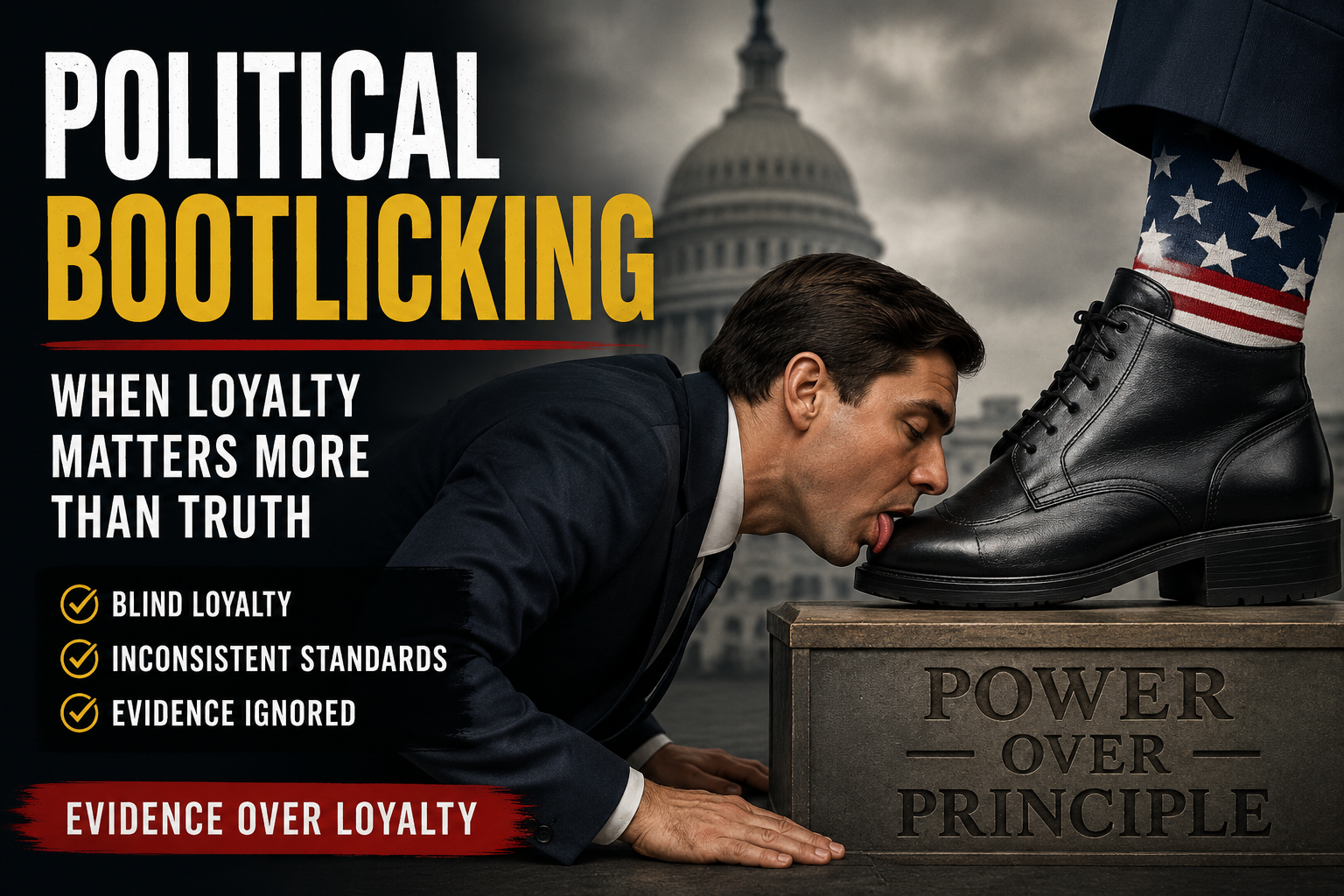
The word “bootlicker” is commonly used as a political insult. Usually as an insult. Usually during arguments online. Usually when somebody appears willing to defend a politician no matter what happens.
But underneath the insult is a real question worth asking:
At what point does normal political support become blind loyalty?
That question matters because democracy depends on citizens being willing to challenge power, including the people they voted for.
What Uncritical Political Deference Means
Uncritical political deference means giving a powerful person, party, or movement loyalty that overrides independent judgment.
In normal language, a bootlicker is someone who seems too eager to please authority. In politics, the insult usually means someone is defending a leader no matter what the evidence shows.
The label should not be applied to supporters as a group. Supporting a candidate, agreeing with policies, or voting for someone is normal politics. The concern begins when support prevents independent evaluation.
Why Critics Apply This Label to Some Trump Supporters
Critics often call some Trump supporters bootlickers because they believe those supporters defend Donald Trump under circumstances where they would condemn anyone else.
The accusation usually comes up when people see behavior like this:
- Excusing contradictions instead of addressing them
- Calling negative reporting fake without checking the facts
- Defending court losses only when the ruling hurts their side
- Treating criticism of Trump as betrayal
- Changing standards depending on which political side is involved
The issue is not simply liking Trump. The issue is whether a person can still apply the same standards to Trump that they apply to everyone else.
When Political Support Becomes Blind Loyalty
The deeper problem is blind loyalty. A person can be loyal to a party, a candidate, or a movement and still think for themselves. But when loyalty becomes more important than truth, facts stop mattering.
That is how political arguments turn into team sports. The question stops being, “Is this true?” and becomes, “Does this help my side?”
Once that happens, evidence gets treated like an inconvenience.
This Is Not Just A MAGA Problem
Uncritical loyalty is not limited to one party, movement, media audience, or influencer community.
It should be evaluated by observable behavior—such as changing evidence standards or excusing contradictions—not assumed from a person’s affiliation.
Trump’s dominant position within the Republican coalition and the sharp partisan divide in assessments of him help explain why critics often focus this accusation on his most committed supporters.
How To Tell The Difference Between Support And Uncritical Deference
Supporting a politician means you agree with enough of their positions to back them.
Uncritical deference means defending a leader even when the available facts do not support the defense.
Here is the simple test:
- Can you name something your side got wrong?
- Can you admit when your preferred politician lied?
- Do your standards stay the same when the other party is involved?
- Can evidence change your mind?
- Can you criticize your own side without feeling like a traitor?
If the answer is no, that is not strong political conviction. That is surrendering your judgment to the team.
Uncritical Deference And Intellectual Inconsistency
One sign of uncritical political deference is applying inconsistent standards.
If executive power is bad when one party uses it but fine when your party uses it, that is not principle.
If court rulings matter only when your side wins, that is not respect for the law.
If media reports are trustworthy only when they help your argument, that is not media literacy.
Uncritical deference can appear when people defend behavior instead of applying a consistent standard.
Why Evidence Matters More Than Loyalty
Politics needs disagreement. It also needs honesty. A country cannot function if every public issue becomes a loyalty test.
Evidence matters because it gives people something outside group identity to measure claims against.
You can support a politician and still demand proof. You can vote for someone and still criticize them. You can agree with a party on policy and still reject excuses, spin, and hypocrisy.
That is not weakness. It is independent civic judgment.
The Bottom Line
Calling someone a bootlicker is usually meant as an insult, but the behavior behind the word is worth examining.
Uncritical political deference occurs when testing whether something is true becomes less important than protecting one’s side.
The cure is simple, even if it is uncomfortable:
Apply the same standard to everyone. Demand evidence. Admit when your side is wrong. Stop treating politicians like kings.
Support is fine. Blind loyalty is the problem.
How we rate claims: See the Evidence Matters Verdict System