Political Claims Without Evidence: 7 Powerful Warning Signs
Political claims without evidence often rely on rumors, screenshots, emotion, missing context, and no primary sources.
Political claims without evidence are everywhere online. People see viral posts, dramatic headlines, screenshots, memes, videos, and commentary that present opinions as facts.
The problem is simple. Many political claims collapse the moment someone asks for proof.
Real fact checking is not about whether you like or dislike a politician. It is about whether the claim can be supported with records, primary sources, credible reporting, and evidence that survives scrutiny.
What Are Political Claims Without Evidence?
Political claims without evidence are claims that sound confident but cannot be traced back to reliable records, documents, transcripts, data, full video, or other checkable sources.
Strong evidence is traceable. Weak claims often depend on trust, emotion, repetition, or loyalty.
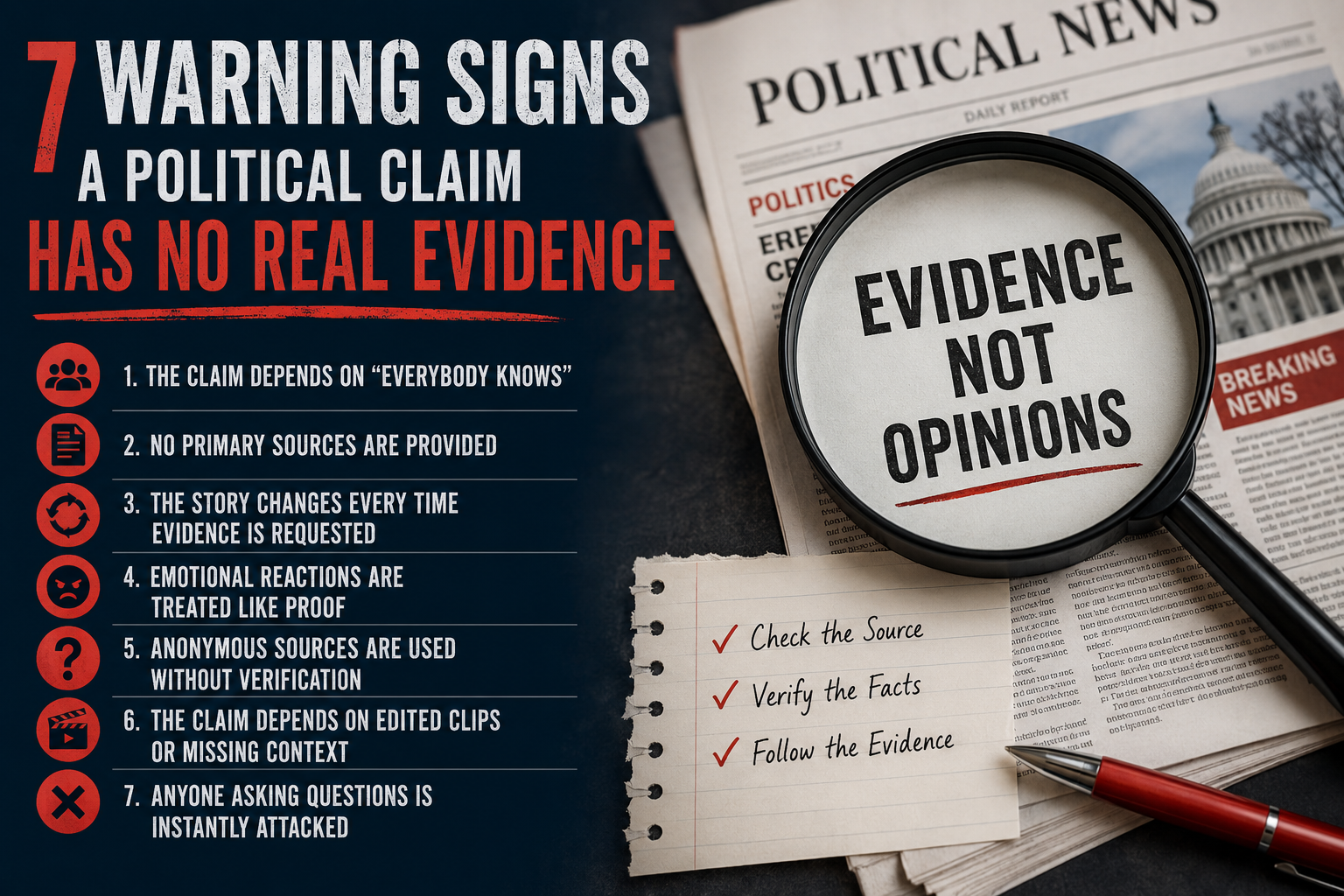
Warning Sign #1: Everybody Knows
One of the biggest warning signs is when a claim relies on popularity instead of proof.
Phrases like “everybody knows,” “people are saying,” and “it is obvious” are not evidence.
Warning Sign #2: No Primary Sources
Strong political claims should connect back to primary evidence whenever possible.
- Court filings
- Government records
- Official transcripts
- Direct interviews
- Raw video footage
- Original documents
Warning Sign #3: The Story Keeps Changing
Claims without proof often evolve every time someone asks questions.
The timeline changes. The explanation changes. The burden of proof changes.
Warning Sign #4: Emotion Replaces Evidence
Anger is not evidence. Fear is not evidence. Outrage is not evidence.
Many viral claims are designed to create an emotional reaction before people stop and verify the information.
Warning Sign #5: Anonymous Sources Without Verification
Anonymous sources can sometimes be legitimate. However, anonymous claims without independent verification should be treated carefully.
Warning Sign #6: Missing Context
Short clips and screenshots can be misleading when important context is removed.
Look for the full interview, speech, document, transcript, or video before treating a claim as proven.
Warning Sign #7: Questions Are Treated as Attacks
Strong evidence welcomes questions. Weak claims fear them.
If basic verification questions are met with insults instead of evidence, that should raise concerns.
How to Check Political Claims Without Evidence
Before sharing a claim, ask whether another person could verify it independently.
- Can you locate the original source?
- Does the evidence support the conclusion?
- Has the information been taken out of context?
- Is the claim based on records or repetition?
- Would you accept the same evidence from the opposite political side?
FAQ: Political Claims Without Evidence
What are political claims without evidence?
They are political claims that are not supported by records, documents, transcripts, public data, official statements, or other checkable sources.
Why do unsupported political claims spread?
They spread because emotion, repetition, identity, and loyalty can make weak claims feel true.
What is the strongest evidence for a political claim?
Primary sources such as court records, government documents, original transcripts, direct video, and public data are usually stronger than secondhand claims.
Related Evidence Matters Resources
External Fact Checking Resources
How we rate claims: See the Evidence Matters Verdict System