
Trump Administration Results: Promises and Measurable Outcomes
Trump promised lower prices, a stronger economy, a secure border, peace, efficient government, law and order, and a better country. The fairest test is not how much activity occurred. It is what measurably improved.
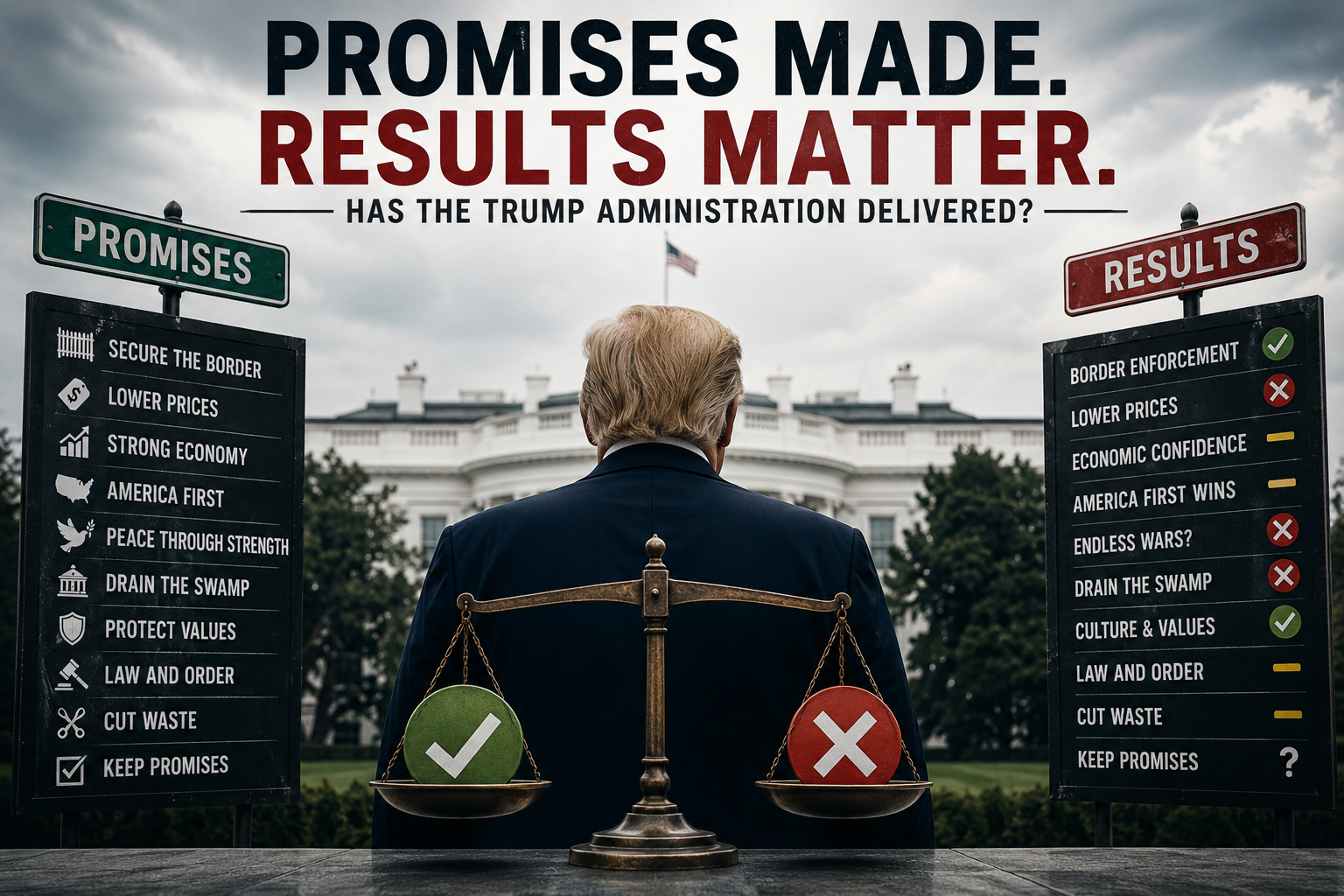
Trump administration results should be measured the same way we would measure any other president: identify the promise, select a fair measurement, examine the current data, and separate real outcomes from political promotion.
Donald Trump has always argued that he is different from ordinary politicians. His supporters often point to his willingness to act quickly, confront institutions, sign executive orders, pressure other countries, and fight political opponents.
Those actions may matter politically.
But action is not automatically a result.
An executive order is an action. A press conference is an action. A tariff is an action. A deportation operation is an action. An investigation is an action.
A result is what happened afterward.
The question is not whether Trump acted. The question is what improved because he acted.
How This Trump Administration Results Scorecard Works
This article does not attempt to assign one overall grade to the entire administration. Different voters value different outcomes, and several policies remain unfinished.
Instead, each section compares a major promise with current measurable evidence available through July 2026.
The labels mean:
- Delivered: Current evidence clearly supports the basic promised outcome.
- Mixed: Some evidence supports the promise, but important weaknesses or conflicting results remain.
- Not yet demonstrated: The available evidence does not establish the promised result.
1. Did Trump Secure the Border?
Border enforcement is one of the strongest areas for Trump supporters who argue that his administration delivered a measurable result.
The administration imposed tougher enforcement policies, increased removals, discouraged unauthorized migration, and reported historically low levels of illegal border crossings.
The White House reported in February 2026 that migrant encounters at the southern border had fallen dramatically during 2025. It also reported hundreds of thousands of deportations and a substantial number of voluntary departures.
The White House is an interested political source, so its characterizations should not be accepted without scrutiny. Still, the broad direction of the available border data supports the conclusion that unauthorized crossings declined sharply under the administration’s policies.
That does not settle every immigration debate.
Americans may still disagree about detention conditions, deportation priorities, legal protections, family separation, labor effects, due process, and the treatment of asylum seekers.
But measured against the specific promise to reduce unauthorized border crossings, this is a clear area in which Trump can point to a result.
2. Did Trump Lower Prices and the Cost of Living?
This promise requires careful wording because lowering inflation is not the same as lowering prices.
Inflation measures how quickly prices are changing. Prices can keep rising even when the inflation rate slows.
In June 2026, the Consumer Price Index fell 0.4 percent from May. That was meaningful monthly relief, largely driven by a decline in energy prices.
But compared with June 2025, overall consumer prices were still 3.5 percent higher. Food prices were 3 percent higher, and groceries were 2.7 percent higher.
Energy costs were especially complicated. Prices fell during June, but energy prices remained substantially higher than one year earlier. The average price of regular gasoline was about $4.05 per gallon during June 2026.
Therefore, the evidence supports two statements at the same time:
- Consumers received some month-to-month relief in June.
- The broader promise of generally lower prices had not yet been demonstrated.
Review the June 2026 Consumer Price Index and U.S. Energy Information Administration gasoline data .
3. Did Trump Create a Stronger Economy?
The economy was growing during the first quarter of 2026, but the evidence does not support either an economic collapse narrative or an unquestionable economic boom.
The Bureau of Economic Analysis estimated that real gross domestic product increased at an annual rate of 1.6 percent during the first quarter of 2026.
That represented continued growth and an improvement from the fourth quarter of 2025, when growth was estimated at 0.5 percent.
However, 1.6 percent growth is moderate. Consumer spending growth also slowed, and the estimate was revised downward from the initial report.
The labor market showed a similar mixed picture.
The unemployment rate was 4.2 percent in June 2026, which remained relatively low. Employers added approximately 57,000 payroll jobs during the month, but that was a modest increase and employment conditions changed little overall.
The fair conclusion is that the economy remained stable and continued growing, but the available data did not establish the extraordinary economic transformation described in some administration messaging.
Review the Bureau of Economic Analysis GDP report and Bureau of Labor Statistics employment data .
4. Are Working Families Better Off?
A strong economy should eventually show up in household income, purchasing power, savings, housing costs, and financial security.
There were some positive signs.
Full-time workers had median weekly earnings of $1,251 during the second quarter of 2026. That was 4.6 percent higher than one year earlier, which exceeded the comparable increase in consumer prices reported for the period.
Real disposable personal income also increased 0.3 percent in May after declining during several earlier months.
Those figures suggest that earnings improved for many workers.
But household finances were not universally strong. The personal saving rate was only 3 percent in May, and families continued facing elevated prices for housing, food, insurance, energy, and other basic expenses.
The result is mixed. Earnings showed improvement, but that does not mean every household became more secure or that earlier affordability problems disappeared.
Review Bureau of Labor Statistics wage and employment data and Bureau of Economic Analysis disposable-income data .
5. Did Trump Reduce Waste and Improve Government?
Trump promised to reduce bureaucracy, eliminate waste, reform agencies, and make the federal government more efficient.
His administration has taken substantial action, including staffing changes, program cancellations, regulatory changes, fraud investigations, agency reorganizations, and spending reductions.
But reducing the number of employees or canceling programs does not automatically prove that government became more efficient.
A valid efficiency measurement should consider:
- How much money was actually saved
- Whether the savings were independently verified
- Whether services became faster or more reliable
- Whether fraud declined
- Whether backlogs increased or decreased
- Whether courts later reversed the actions
- Whether costs were merely shifted elsewhere
The administration has published extensive lists of claimed savings and accomplishments. Those claims deserve review, but activity and projected savings are not the same as verified long-term results.
6. Did Trump Deliver Peace Through Strength?
Foreign policy is difficult to measure with one statistic.
Supporters may point to military pressure, negotiated agreements, increased defense activity, pressure on allies, sanctions, or deterrence as evidence of strength.
Critics may point to ongoing conflict, instability, increased military costs, damaged alliances, civilian harm, or new security risks.
The test should be based on specific promised outcomes.
- Which war was ended?
- What agreement was signed?
- Did the fighting actually stop?
- How long did the result last?
- Did the agreement make Americans safer?
- What costs or new risks followed?
Announcing victory, claiming deterrence, or saying a conflict has been settled is not enough by itself.
A durable foreign-policy result requires an identifiable agreement, observable compliance, measurable security improvements, and enough time to judge whether the result lasted.
7. Did Trump Make the Country Stronger and More United?
National strength is broader than partisan enthusiasm.
A president can energize supporters while simultaneously deepening hostility, distrust, and alienation among everyone else.
Measuring unity requires more than rally attendance or approval within one political party.
Useful measures would include public trust, confidence in elections, confidence in institutions, political violence, willingness to accept legitimate election outcomes, and the ability of Americans to agree on basic facts.
Trump has clearly strengthened loyalty within his political movement.
That is not the same as strengthening national unity.
Until broader evidence shows improved trust and reduced division across the country, the promise of national unity remains unproven.
The Trump Administration Results at a Glance
| Promise | Current Evidence | Assessment |
|---|---|---|
| Secure the border | Unauthorized crossings fell sharply under tougher enforcement. | Strong evidence of delivery |
| Lower prices | Prices fell during June but remained 3.5 percent higher than one year earlier. | Mixed |
| Strengthen the economy | GDP grew 1.6 percent in the first quarter and unemployment remained 4.2 percent. | Mixed but stable |
| Help working families | Full-time earnings increased faster than inflation, but affordability pressures remained. | Mixed |
| Reduce government waste | Major actions occurred, but verified long-term savings and service improvements remain unclear. | Not yet demonstrated |
| Deliver peace through strength | Claims of success require conflict-specific evidence and proof that results lasted. | Disputed |
| Unite and strengthen the country | Supporter loyalty remains strong, but broader national unity has not been established. | Not demonstrated |
Fighting Is Not the Same as Governing
One reason Trump maintains intense support is that many voters value his willingness to fight.
They believe previous Republicans compromised too often, accepted institutions they considered biased, or failed to pursue conservative priorities aggressively.
That political style is part of Trump’s appeal.
But governing requires more than fighting.
Every administration must eventually answer one question: What measurably improved because you were in charge?
Not what you announced.
Not what you blamed on the previous president.
Not what your supporters cheered.
What actually got better?
Judge Every President by the Same Standard
This test should not apply only to Donald Trump.
It should apply to every president and every political party.
- What exactly did the candidate promise?
- What measurement would demonstrate success?
- What was the starting point?
- What changed after the policy took effect?
- How much control did the president actually have?
- What evidence contradicts the administration’s claims?
- Who benefited and who carried the cost?
Presidents should receive credit for verified improvements.
They should also receive responsibility for measurable failures, unintended consequences, and promises they did not fulfill.
The Bottom Line
The Trump administration has delivered substantial political action.
It has changed immigration enforcement, federal policy, regulations, agency priorities, trade policy, and the political direction of the country.
But the measurable results are not all the same.
Border enforcement is a strong example of a promise followed by a visible outcome.
Economic growth, employment, wages, and household income present a more mixed but not uniformly negative picture.
The promise of broadly lower prices has not yet been fulfilled, even though consumers received some recent relief.
Claims about government efficiency, lasting peace, and national unity still require stronger evidence.
That is not a partisan conclusion.
It is what happens when every promise is separated from the political sales pitch and compared with the measurable result.
Promises were made. Some results are visible. Others remain mixed, disputed, or unproven.
Frequently Asked Questions About Trump Administration Results
Has Trump delivered on border security?
Available evidence indicates that unauthorized southern-border crossings declined sharply under the administration’s tougher enforcement policies. Other questions about legality, humanitarian effects, and immigration policy remain separate debates.
Has Trump lowered prices?
Consumer prices declined during June 2026, but they remained 3.5 percent higher than one year earlier. That means recent price relief had not yet produced broadly lower year-over-year prices.
Is the economy growing under Trump?
Yes. Real GDP increased at a 1.6 percent annual rate during the first quarter of 2026. The economy was growing, although the rate was moderate.
Are wages increasing faster than inflation?
Median weekly earnings for full-time workers increased 4.6 percent from one year earlier during the second quarter of 2026, exceeding the comparable reported increase in consumer prices.
Has Trump made government more efficient?
The administration has made extensive changes and claimed substantial savings. A complete judgment requires independently verified savings, service-quality measurements, legal outcomes, and long-term evidence.
What is the fairest way to judge a presidential promise?
Identify the exact promise, select a measurable standard, establish the starting point, examine what changed, account for outside factors, and compare the final result with what was originally promised.
Sources for the Curious
- U.S. Bureau of Labor Statistics: June 2026 Consumer Price Index
- U.S. Bureau of Labor Statistics: Employment and earnings
- U.S. Bureau of Economic Analysis: First-quarter 2026 GDP
- U.S. Bureau of Economic Analysis: May 2026 income and spending
- U.S. Energy Information Administration: Regular gasoline prices
- White House: Administration achievements and claims
Data and assessments in this article are based on information available through July 23, 2026. Economic statistics are routinely revised. This article separates administration claims from independent federal measurements and does not attempt to assign one overall partisan grade.
How we rate claims: See the Evidence Matters Verdict System