
How Did Trump’s Actions Affect U.S. Democratic Institutions? 7 Documented Examples
Donald Trump’s actions affected U.S. democratic institutions, but they did not occur in isolation. The documented record includes challenges to certified election results, pressure on public officials, repeated attacks on institutional credibility, and demands for personal loyalty.
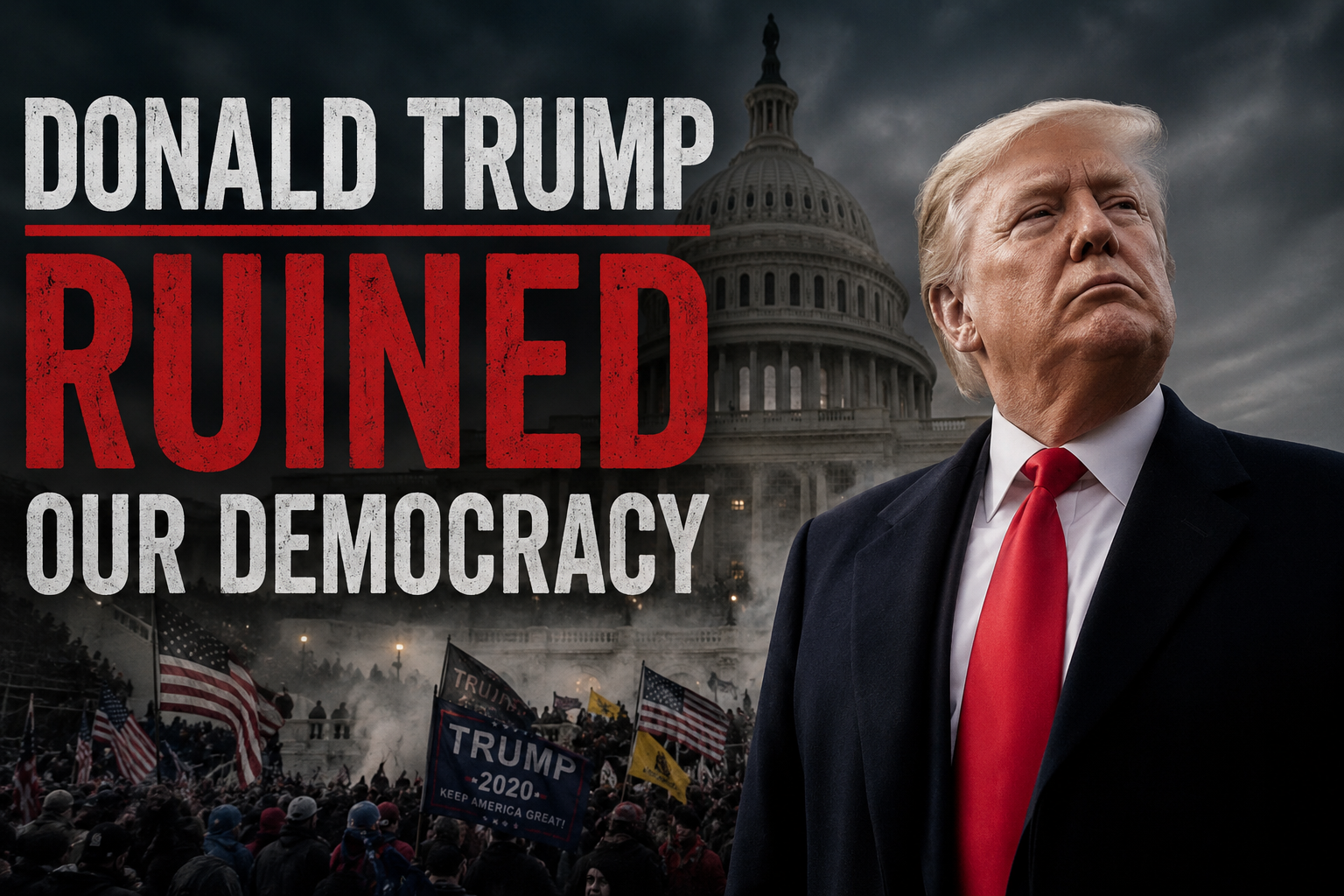
Donald Trump’s actions affected U.S. democratic institutions, but he did not act alone.
The broader record also includes actions by elected officials, media figures, political organizations, attorneys, activists, and supporters.
Some elected officials supported or declined to challenge claims that lacked sufficient evidence.
Some media figures amplified unsupported claims, sometimes alongside commercial or political incentives.
Some political organizations emphasized loyalty to Trump over institutional findings and constitutional processes.
Some supporters continued to accept claims after audits, recounts, and court proceedings failed to establish outcome-changing fraud.
But Trump still bears responsibility for his own actions.
After losing the 2020 election, he promoted the idea that an American election should only be trusted when it produced the result he wanted.
That went beyond ordinary political disagreement.
It raised questions about a core democratic norm: candidates may challenge an election through lawful procedures, but those challenges still depend on evidence and legal findings.
Democratic systems depend on lawful election outcomes being accepted when challenges do not produce evidence sufficient to overturn them.
1. Trump Continued Election Claims After Official Reviews
After the 2020 election, Trump did not merely request recounts or file legal challenges.
Those steps were available to him, and using them was not inherently undemocratic.
The problem came when the investigations, recounts, audits, court proceedings, and reviews failed to establish fraud sufficient to change the outcome, but Trump continued claiming the election was stolen.
His own attorney general, William Barr, publicly stated that the Justice Department had not found widespread fraud capable of changing the result.
Courts reviewing post-election cases repeatedly rejected claims because the evidence or legal arguments did not justify the requested relief.
Some cases were dismissed on procedural grounds. Others were withdrawn. Several courts considered the facts and still found the allegations unsupported.
That distinction matters.
It would be inaccurate to claim that every election lawsuit received a complete trial on the merits. It would be equally inaccurate to claim that the court record established a stolen election.
It did not.
Yet the absence of outcome-changing evidence did not stop the accusation.
Trump continued promoting the stolen-election claim after multiple reviews failed to establish outcome-changing fraud, reinforcing distrust among many supporters.
That was the first documented way his conduct affected democratic trust.
He encouraged continued belief in a claim that had not been established by the available evidence.
Review the results of major lawsuits involving the 2020 election .
2. Trump Pressured State Election Officials
The recorded Georgia phone call is one of the clearest pieces of evidence from the entire post-election period.
On January 2, 2021, Trump spoke with Georgia Secretary of State Brad Raffensperger and other state officials.
During that call, Trump said:
“I just want to find 11,780 votes, which is one more than we have.”
That number was not random.
It was the number Trump needed to move ahead of Joe Biden’s certified Georgia total.
Trump and his defenders have argued that he genuinely believed the result was wrong and wanted officials to identify lawful votes.
But belief does not erase the content of the call.
Trump repeatedly presented allegations that Georgia officials disputed, insisted that he had won, raised the possibility of criminal consequences, and asked officials to produce the exact number needed to reverse his loss.
The request for the precise number needed to reverse the certified margin is central to evaluating the call.
It documents direct presidential pressure on state election officials after the certified result went against him.
3. Trump Supported Efforts Aimed at Blocking or Delaying Certification
The effort to remain in power extended beyond public accusations and lawsuits.
The House January 6 Committee concluded that Trump and his allies pursued a multi-part effort to overturn the lawful result.
The report examined pressure on state officials, efforts involving alternate electoral certificates, pressure on the Justice Department, pressure on Vice President Mike Pence, and attempts to interfere with the certification process.
The committee’s findings were produced by a congressional investigation. They are not the same thing as a criminal conviction.
But they are supported by testimony, documents, communications, recordings, and other materials that citizens can review.
That documented effort matters because elections are not decided by which candidate can pressure the most officials after voting ends.
They are decided by lawful ballots, certified totals, court review, and constitutional procedures.
Read the January 6 Committee final report and supporting materials .
4. Trump’s Election Claims and Pressure Campaign Preceded January 6
January 6 did not appear out of nowhere.
It followed weeks of stolen-election claims, conspiracy theories, pressure campaigns, failed legal challenges, attacks on election workers, and promises that extraordinary action could still prevent certification.
Trump told supporters the election had been stolen from them.
He encouraged them to come to Washington.
He continued pressuring Pence to reject or delay certified electoral votes even though Pence lacked the claimed authority to unilaterally change the result.
After the Capitol was breached, Trump did not immediately and forcefully tell the attackers to leave.
The peaceful transfer of power is not a ceremonial detail.
It is one of the central promises of constitutional democracy.
Candidates are allowed to run.
They are allowed to challenge close results.
They are allowed to criticize election procedures.
But when those procedures confirm defeat and the evidence does not justify overturning the result, they are expected to concede and transfer power peacefully.
Trump did not concede the election before leaving office and continued challenging the result after certification.
5. Trump Targeted Officials Who Rejected His Election Claims
Trump did not only attack Democrats.
He attacked Republicans who refused to help him overturn the result.
He attacked Republican governors.
He attacked Republican secretaries of state.
He attacked Republican election officials.
He attacked Republican judges.
He attacked his own vice president.
Many officials Trump criticized said they were following their legal or constitutional duties.
Their refusal to support his effort to overturn the result made them political targets.
This created a dangerous loyalty test:
- If you supported Trump’s accusation, you were called a patriot.
- If you asked for evidence, you were treated as disloyal.
- If you followed the certified result, you became a political target.
- If you corrected a false claim, you were accused of joining the conspiracy.
That kind of loyalty pressure can conflict with constitutional government when officials are expected to follow law and evidence rather than personal demands.
Constitutional government requires officials to follow the law even when the president demands something else.
6. Trump Attacked the Credibility of Institutions That Rejected His Claims
Trump repeatedly portrayed institutions and officials that rejected his election claims as corrupt, biased, or disloyal.
Courts rejected the claim, so the courts were corrupt.
Republican state officials rejected the claim, so those officials were corrupt.
Trump-appointed officials rejected the claim, so they were disloyal.
Journalists corrected the claim, so journalism was fake.
Fact checkers reviewed the evidence, so fact checking was partisan.
Election workers followed ordinary procedures, so election workers became suspects.
This pattern made corrective evidence easier for supporters to dismiss.
Every source supporting Trump was treated as trustworthy.
Every source contradicting Trump became evidence of the conspiracy.
Once a movement reaches that point, evidence can no longer correct the claim because contradictory evidence is automatically rejected.
Democratic systems depend on shared procedures for resolving factual and legal disputes.
Democratic government requires citizens to accept some common methods for checking facts, resolving disputes, counting votes, and reviewing government decisions.
7. Election Denial Became a Continuing Political Movement
The damage extended beyond the 2020 election.
Trump repeatedly framed adverse election outcomes as evidence of wrongdoing, even when the supporting evidence was not established.
That idea has influenced candidates, political organizations, media figures, donors, activists, and voters.
It turns every future election into a potential conspiracy.
Every close count becomes suspicious.
Every delay becomes evidence of cheating.
Every administrative mistake becomes proof of a plot.
Every official who certifies an unwanted result becomes an enemy.
Democracy requires losers to accept defeat when the evidence and lawful process establish the result.
Not forever.
Not happily.
But peacefully.
When political actors treat defeat itself as proof of cheating, public confidence in democratic elections can erode.
What the Evidence Establishes
| Documented Event | What It Establishes | What It Does Not Automatically Establish |
|---|---|---|
| Trump repeatedly claimed the election was stolen. | He promoted the claim after reviews failed to establish outcome-changing fraud. | It does not prove that every supporter knowingly lied. |
| The Georgia call included a request to find 11,780 votes. | Trump asked state officials for the precise number needed to reverse his loss. | The recording alone does not resolve every disputed legal question. |
| Trump and allies pursued multiple post-election strategies. | The effort extended beyond ordinary recounts and lawsuits. | A congressional finding is not identical to a criminal conviction. |
| The Capitol was attacked during certification. | The peaceful transfer process was violently disrupted. | It does not make every person at the rally legally responsible for the attack. |
| Officials who resisted Trump were attacked politically. | Loyalty to Trump was repeatedly placed above acceptance of the certified result. | It does not prove every criticism of an official was illegitimate. |
Trump Exposed a Weakness He Did Not Create
Trump did not invent political lying.
He did not invent partisan media.
He did not invent conspiracy theories.
He did not invent public distrust.
He repeatedly used those existing weaknesses to build political support around distrust and grievance.
He found people who wanted simple answers.
He found people who wanted their anger validated.
He found people who treated correction as disrespect.
He found politicians more afraid of losing a primary than of weakening the Constitution.
He found media figures willing to repeat unsupported stories because those stories attracted audiences.
He built a political identity in which institutional findings were often accepted or rejected according to whether they supported his claims.
That is why The Evidence Matters exists.
Democracy cannot survive when facts become optional and every loss becomes a conspiracy.
The Hardest Question Is Who Helped Him
The documented record shows that Trump’s conduct placed substantial pressure on democratic institutions and norms.
But history will also have to examine why so many people helped.
- Why did elected officials repeat claims they could not prove?
- Why did partisan media keep selling stolen-election theories?
- Why did voters accept social-media claims instead of demanding records?
- Why were Republican election officials threatened for performing their duties?
- Why did January 6 fail to end the election-denial movement?
- Why did loyalty to one politician become more important than accepting verified results?
Trump was a central driver of the post-election campaign.
Allies helped sustain and spread the campaign.
The movement continued advancing many of its claims after January 6.
The effects on election trust and political institutions remain part of the historical record.
Show the Evidence
If the 2020 election was stolen, show the evidence.
Not a meme.
Not a shortened video.
Not a Facebook post.
Not a podcast accusation.
Not a theory about what might have happened.
Show evidence capable of proving what happened, how many lawful votes were affected, and whether the verified number changed the outcome.
That means records.
Documents.
Verifiable data.
Authentic evidence with a reliable chain of custody.
Evidence capable of surviving serious review.
If the evidence is real, present it. If the evidence cannot be produced, stop treating the accusation as proven.
Frequently Asked Questions
How did Trump damage American democracy?
Trump damaged American democracy by promoting an unsupported stolen-election claim, pressuring officials, supporting efforts to interfere with certification, attacking officials who resisted him, and encouraging distrust of institutions that rejected his allegations.
Did courts prove that the 2020 election was stolen?
No. Some cases were dismissed on procedural grounds and others were withdrawn, but the court record did not establish fraud sufficient to overturn the certified presidential result.
What did Trump say during the Georgia phone call?
Trump told Georgia officials that he wanted to find 11,780 votes, one more than the number he needed to move ahead of Joe Biden in Georgia.
Was January 6 the only democratic damage?
No. January 6 was the most visible event, but it followed a broader campaign involving false claims, pressure on officials, attacks on election workers, attempts to interfere with certification, and efforts to discredit institutions that rejected Trump’s allegations.
Did Trump act alone?
No. Trump was supported by elected officials, attorneys, political organizations, media figures, activists, and voters. Recognizing their roles does not remove Trump’s responsibility for his own conduct.
Is criticizing election administration undemocratic?
No. Citizens and candidates have every right to investigate mistakes, request recounts, file lawful challenges, and propose reforms. The democratic problem begins when accusations continue after the evidence fails and officials are pressured to change a lawful result.
Sources for the Curious
- U.S. Government Publishing Office: January 6 Committee Final Report and Supporting Materials
- January 6 Committee Report: Executive Summary
- Transcript and Audio of the Trump Raffensperger Georgia Call
- CBS News: Trump Georgia Call Recording and Context
- Campaign Legal Center: Results of 2020 Election Lawsuits
This article distinguishes documented events from interpretation. Congressional findings are not the same as criminal convictions, and dismissed lawsuits did not all receive identical forms of review. The central conclusion is based on the broader documented record of false election claims, pressure on officials, interference efforts, attacks on truth-tellers, and damage to public trust.
How we rate claims: See the Evidence Matters Verdict System