
January 6 and Voter Priorities: Evidence and Interpretation
Why some voters overlooked January 6 is one of the most uncomfortable questions in American politics.
January 6 was not a normal political controversy. It was an attack on the U.S. Capitol during the certification of a presidential election. For many Americans, that makes it a line crossing event.
So why did millions of voters still support Donald Trump afterward?
The answer involves priorities, identity, distrust, fear, partisan loyalty, and the human habit of excusing behavior when it comes from our own side.
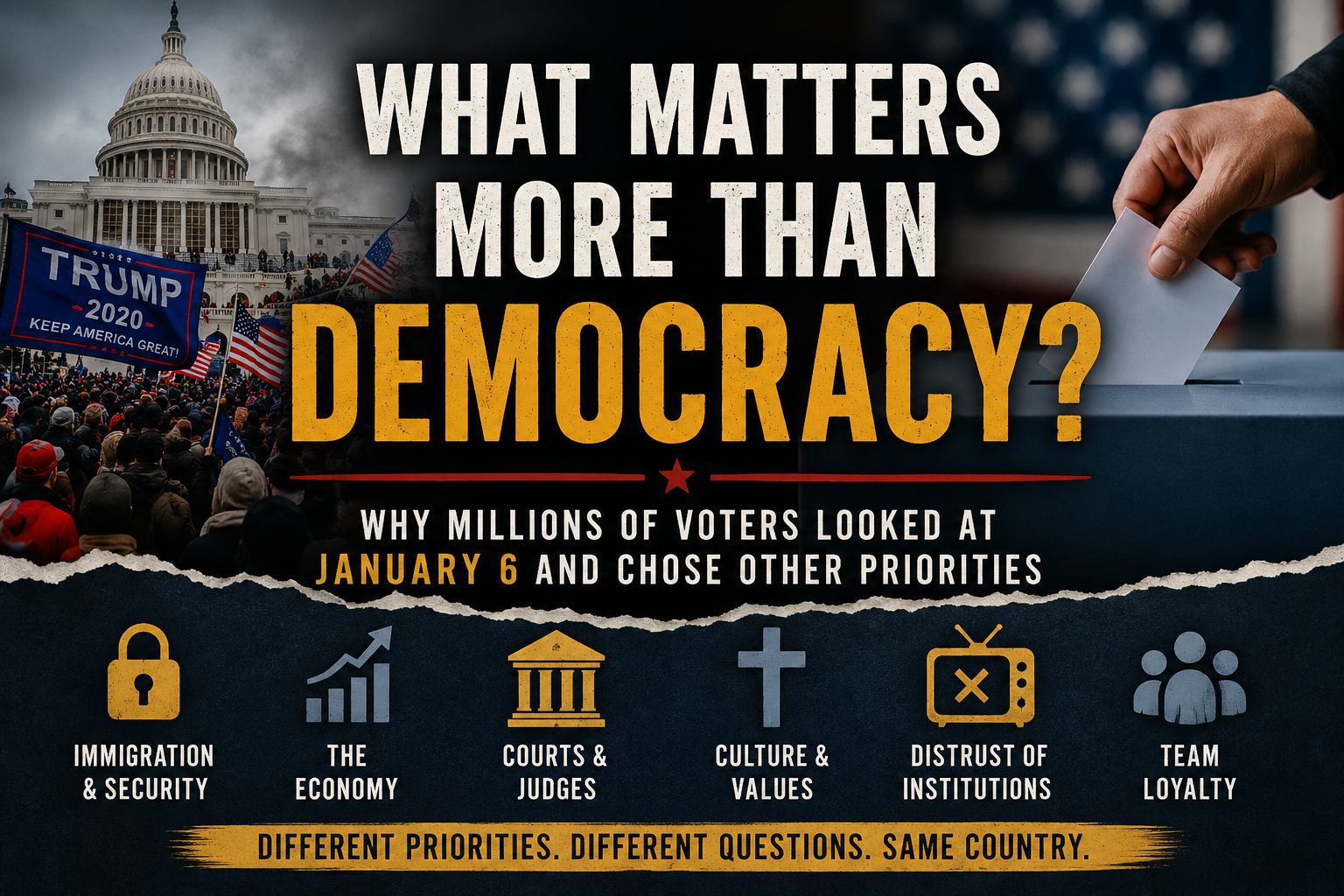
Why Some Voters Overlooked January 6
The hardest part to understand is not that people disagreed about policy. Americans have always disagreed about policy.
The harder question is this:
What issue mattered so much that some voters were willing to overlook an attack on the peaceful transfer of power?
For some voters, the answer was immigration. For others, it was the economy, crime, courts, guns, religion, cultural issues, or strong opposition to the Democratic Party.
That does not settle whether the choice was justified. It helps explain how different priorities shaped the decision.
The Two Different Questions Americans Were Asking
Many Trump critics were asking:
What good are tax cuts, judges, or border policies if the person pursuing them undermines the system that allows voters to choose leaders?
Many Trump supporters were asking a different question:
Which candidate will fight for the issues I care about most?
That is why the debate often goes nowhere. One side is talking about the foundation. The other side is talking about the furniture.
The Burning House Analogy
Imagine a house is on fire.
One person runs inside to save family photos, furniture, and valuables.
Another person says, “Forget the couch. The foundation is cracking.”
Both people care about the house. But they are not focused on the same danger.
For January 6 critics, democracy is the foundation. Without peaceful elections and the transfer of power, everything else sits on unstable ground.
For some Trump supporters, issues like immigration, inflation, crime, guns, courts, and cultural change felt more immediate. They treated January 6 as a damaged wall, not a cracked foundation.
That is the real divide.
Concern 1: Immigration
Immigration was one of the biggest reasons some voters stayed with Trump.
To those voters, border security was not just another issue. It was tied to national identity, safety, jobs, crime, drugs, and cultural change.
Their thinking often looked like this:
January 6 was bad, but I think an unsecured border is worse long term.
That is the tradeoff. They were not always denying January 6 happened. Some were deciding that another fear mattered more.
Whether that fear matched the available evidence or was amplified by political messaging is a separate question. But politically, it mattered.
Concern 2: The Economy
Some voters cared more about inflation, gas prices, wages, taxes, regulations, and retirement accounts.
Their calculation was simple:
I may not like what happened on January 6, but I think Trump is better for my wallet.
This is one of the most common political tradeoffs. People often vote based on what they believe will affect their daily life first.
The problem is that democracy also affects daily life. It just does it more slowly.
Concern 3: Courts and Judges
For many conservatives, courts were the prize.
Trump appointed three Supreme Court justices during his first term. For voters focused on abortion, gun rights, religious liberty, business regulation, and executive power, that mattered enormously.
Their thinking often looked like this:
I do not like Trump’s behavior, but I want conservative judges for the next generation.
That is not a small concern. Federal judges can shape American law for decades.
But again, the question remains: should any policy victory outweigh the peaceful transfer of power?
Concern 4: Cultural Fear
Some voters viewed Trump as a weapon against cultural change.
They believed schools, media, universities, corporations, entertainment, and government agencies had moved too far away from their values.
To them, Trump was not just a candidate. He was a protest vote with a microphone.
That is why behavior that looked reckless to critics looked refreshing to supporters. They saw him breaking rules they already believed were rigged.
That matters because distrust in the rules can make violations of those rules easier to excuse.
Concern 5: Distrust of the Media and Government
Another major reason some voters overlooked January 6 was distrust.
If someone believes the media lies, Congress is corrupt, the justice system is political, and federal agencies are working against them, then evidence from those institutions will not land the same way.
That creates a closed loop:
The institutions say January 6 was serious. But I do not trust those institutions. Therefore, I do not trust their description of January 6.
This is how distrust becomes political armor.
It does not have to disprove the evidence. It only has to make people ignore it.
The Football Team Analogy
Politics now works too much like sports.
If the other team commits a dirty hit, fans call it proof they are corrupt.
If your team commits the same dirty hit, fans say the refs are biased, the video is misleading, or the other team started it.
That is partisan identity.
Once politics becomes team loyalty, evidence gets treated like a scoreboard. People do not ask, “What happened?” They ask, “Does this help or hurt my side?”
The Law Enforcement and Military Paradox
This is why support from some law enforcement and military communities surprises so many people.
January 6 included violence against police officers. It also involved an attempt to stop Congress from certifying an election result.
For people who view law enforcement and military service as being rooted in oath, order, chain of command, and constitutional duty, continued support for Trump can seem contradictory.
But political identity does not disappear because someone wears a uniform.
Law enforcement officers and military members are still human beings. They still have political identities, media habits, families, churches, social circles, fears, and policy preferences.
Some saw January 6 as disqualifying. Others minimized it. Others viewed prosecutions as unfair. Others separated Trump from the crowd. Others believed Democrats were still worse.
That is the uncomfortable part. Professional identity does not automatically override political identity.
The One Bad Day Excuse
Another common move is the “one bad day” excuse.
Some voters treated January 6 as one ugly event in an otherwise acceptable political record.
That framing matters.
If January 6 is seen as one riot, it becomes easier to minimize.
If January 6 is seen as the result of a months long effort to overturn an election, it becomes much harder to excuse.
That is why the timeline matters. The fake elector pressure, the attacks on election workers, the pressure on state officials, the pressure on Mike Pence, and the public claims of fraud all matter.
January 6 was not just a crowd. It was the end point of a larger pressure campaign.
The Democracy Hypocrisy Problem
Most people say they support democracy.
The harder test comes when democracy gives them a result they hate.
Research on democratic norms has found that many voters become more flexible about democracy when their own side benefits. That pattern is sometimes called democratic hypocrisy.
Plain English version:
People love rules until the rules help the other side win.
This is not only a MAGA problem. It is a human problem.
But January 6 made the issue impossible to ignore because the pressure was aimed directly at the transfer of presidential power.
The Bad Mechanic Analogy
Imagine you have a mechanic who gives you cheap oil changes.
You like the price. You like the service. You like how he talks to you.
Then one day you find out he cut the brake lines on a customer’s car because he was mad about a bad review.
You would not say, “Well, his oil changes are still affordable.”
You would say, “This person cannot be trusted with the car.”
That is how January 6 critics see Trump.
They are not only judging policy. They are judging whether he can be trusted with the system itself.
Why Arguments About January 6 Rarely Change Minds
Arguments about January 6 rarely change minds because people are often arguing about different things.
One person says:
He tried to overturn an election.
The other replies:
Gas was cheaper.
Those are not matching arguments.
It is like one person saying the pilot is drunk and the other person saying the in flight snacks are good.
The snacks might be good. That does not answer the pilot problem.
What This Actually Means
The question is not whether voters had concerns that mattered to them.
Of course they did.
The question is whether those concerns should have outweighed January 6.
If the peaceful transfer of power is optional, then elections become conditional. If elections become conditional, then democracy becomes a slogan instead of a system.
That is why January 6 matters.
Not because every Trump voter had the same motive. They did not.
Not because every concern they had was fake. Some were real.
January 6 matters because it tested whether voters believed the rules still applied when their side lost.
Final Thought
Some voters overlooked January 6 because they cared more about immigration, the economy, judges, guns, cultural issues, or beating Democrats.
That is the explanation.
But explanation is not the same as excuse.
A country can survive bad policies. It can survive bad speeches. It can survive bad politicians.
What it cannot survive forever is a political culture where the rules only matter when your side wins.
That is the real warning.
How we rate claims: See the Evidence Matters Verdict System